If you find texts in this archive useful, please do not copy except for private study
("fair use").
Jacoby explains the word ARBATEL [Heb. ARBOThIM = fourfold + AL = God]
as another indirect way or saying
Tetragrammaton, using the form αρβαθ’Ιαω
i.e. the four-letter (name) of Jao (IHVH) often seen in the Greek Magical Papyri.
(Jacoby in Bächtold-Stäubli, Hanns, Handwörterbuch des deutschen aberglaubens,
Berlin: Walter de Gruyter & Co., Berlin und Leipzig, 1927, Band 1, pp. 568.)
In editing the Latin text I have maintained the capitalization and
diacritics used in the 1575 edition. I have expanded the tildes where
they occur however. I have silently corrected some of the more obvious typos.
In a few places I have
added text in square brackets [], mainly to improve searchability.
In 1655 it was translated into English by Robert Turner.
Note that Turner did not preserve the interesting use of capitalized
words.
There is another English translation in MSS, Sloane 3851,
fol. 10r-29v. It is apparently independent of Turner's translation.
There is a note on fol. 2v that "this book is the handwriting of one
Mr. Arthur Gauntlet, who professed physic [i.e. medicine], and lived
about Gray's Inn Lane." The endsheet also has the words
"Ann Savadge is Roseman, Aune (?)."
Another interesting feature of this manuscript is that it
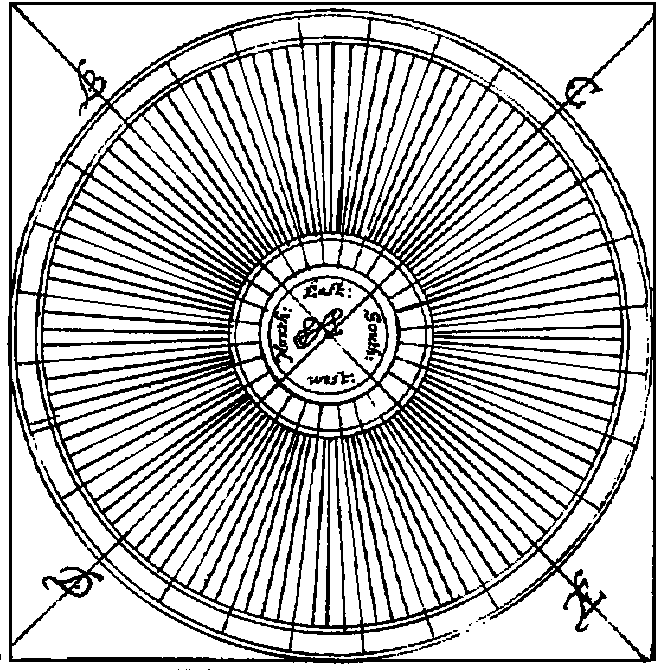
includes a drawing of the "Seal of Secrets" (aphorism 27)
which is described but not illustrated in the original edition.
Another manuscript that includes a version of the "Seal of Secrets" is
Leipzig Cod. Mag. 55.
NOTE how north (septentrionalis) and south (meridies) are mislabelled in manuscript; I have them corrected here.
The often-reproduced diagram on the title page of Luppius' edition
— with the names Saturiel, Ioviel, Gabriel, Oriel, and Pomiel —
is apparently a printer's mark of Luppius, since he used it
in other publications. It does not appear in the original Latin or Turner's edition.
Luppius' edition has other innovations which I have not chosen to
incorporate at this time.
אָרבּעַתּאֵל
Of the Magic of the Ancients,
The greatest Studie of Wisdom.
In all things, ask counsel of the Lord;
and do not thou think, speak, or do
any thing, wherein God is not thy
counsellor.
Proverbs 11.
He that walketh fraudulently, revealeth secrets: but he that
is of a faithful spirit, concealeth the matter.
ARBATEL of MAGICK:
or,
The spiritual Wisdom of the Ancients,
as well Wise-men of the people of God,
as MAGI of the Gentiles: for the illustration
of the glory of God, and his
love to Mankinde.
Now first of all produced out of darkness into the
light, against all caco-Magicians, and contemners of the gifts
of God; for the profit and delectation of all those, who do truely
and piously love the creatures of God, and do use them with thanksgiving,
to the honour of God, and profit of themselves and their neighbours.
|
אָרבּעַתּאֵל
ARBATEL
De Magia Veterum
Summum Sapientiae Studium.
In omnibus consule Dominum, et nihil cogites,
dicas, facias, quod tibi Deus
non consuluerit.
BASILEÆ,
1575.
Arbatel
DE MAGIA
seu
PNEVMATICA
VETERVM TVM MA-
gorum populi DEI, tum Mago-
rum Gentium, pro illustratio-
ne gloriæ & Philan-
tropias DEI.
Nunc primùm ex tenebris in lucem
producta, contra Cacomagos & contemptores
donorum Dei, ad vtilitatem &
delectationem omnium, qui verè &
piè delectantur DEI Creaturis: & illis
cum gratiarum actione vtuntur ad
honorum Dei, & vtilitatem
sui & proximi.
|
Arbatel of Magic
Translated into English by Robert turner,
London 1655.
The PREFACE
To the unprejudiced Reader
As
the fall of man made himselfe and all
other creatures subject to vanity; so, by
reason thereof, the most noble and excellent
Arts wherewith the Rational soul was indued, are by the rusty
canker of Time brought unto Corruption. For Magick itself, which
the ancients did so divinely contemplate, is scandalized with
bearing the badge of all diabolical sorceries: which Art (saith
Mirandula [Pico]) Pauci intelligunt, multi reprehendunt, & sicut
canes ignotos semper allatrant: Few understood, many reprehend,
and as dogges barke at those they know not: so doe many condemn
and hate the things they understand not. Many men there are, that
abhor the very name and word Magus, because of Simon
Magus, who being not Magus, but Goes, that is,
familiar with evil Spirits, usurped that Title. But Magicke and
Witchcraft are far differing Sciences; whereof Pliny* being
ignorant, scoffeth thereat: for Nero (saith Pliny)
who had the most excellent Magicians of the East sent to him by
Tyridates king of Armenia, who held that kingdom
by him, found the Art after long study and labour altogether ridiculous.
Now Witchcraft and Sorcery, are works done merely by the devil,
which with respect unto some covenant made with man, he acteth
by men his instruments, to accomplish his evil ends: of these,
the histories of all ages, people and countries, as also the holy
Scriptures, afford us sundry examples.
[* Plin. lib. 30. Nat. Hist.]
But Magus is a Persian word primitively, whereby is expressed
such a one as is altogether conversant in things divine; as Plato
affirmeth, the Art of Magick is the art of worshipping God: and
the Persians call their gods ![[Magos]](../gifs/arbatel1.gif) hence Apollonius
saith, that Magus is either hence Apollonius
saith, that Magus is either  ,
or ,
or  ,
that is, that Magus is a name sometime of him that is a god by
nature, & sometimes of him that is in the service of God:
in which latter sense it is taken in Matt., 2.1,2. when the wise
men came to worship Jesus, and this is the first and highest kind,
which is called divine Magick; and these the Latins did entitle
sapientes, or wise men: for the feare and worship of God,
is the beginning of knowledge. These wise men the Greeks call
Philosophers; and amongst the Egyptians they were termed
Priests; the Hebrews termed them Cabalistos, Prophets,
Scribes and Pharisees; and amongst the Babylonians they were differenced
by the name of Caldeans; & by the Persians they were
called Magicians: and one speaking of Sosthenes,
one of the ancient Magicians, useth these words: Et verum Deum
merita majestate prosequitur, & angelos ministros Dei, sed
veri ejus venerationi novit assistere; idem dæmonas prodit
terrenos, Vagos, humanitatis inimicos; Sosthenes ascribeth
the due Majesty to the true God, & acknowledgeth that his
Angels are ministers and messengers which attend the worship of
the true God; he also hath delivered, that there are devils earthly
and wandering, and enemies to mankind. ,
that is, that Magus is a name sometime of him that is a god by
nature, & sometimes of him that is in the service of God:
in which latter sense it is taken in Matt., 2.1,2. when the wise
men came to worship Jesus, and this is the first and highest kind,
which is called divine Magick; and these the Latins did entitle
sapientes, or wise men: for the feare and worship of God,
is the beginning of knowledge. These wise men the Greeks call
Philosophers; and amongst the Egyptians they were termed
Priests; the Hebrews termed them Cabalistos, Prophets,
Scribes and Pharisees; and amongst the Babylonians they were differenced
by the name of Caldeans; & by the Persians they were
called Magicians: and one speaking of Sosthenes,
one of the ancient Magicians, useth these words: Et verum Deum
merita majestate prosequitur, & angelos ministros Dei, sed
veri ejus venerationi novit assistere; idem dæmonas prodit
terrenos, Vagos, humanitatis inimicos; Sosthenes ascribeth
the due Majesty to the true God, & acknowledgeth that his
Angels are ministers and messengers which attend the worship of
the true God; he also hath delivered, that there are devils earthly
and wandering, and enemies to mankind.
So that the word Magus of itself imports a Contemplator
of divine & heavenly Sciences; but under the name Magick,
are all unlawful Arts comprehended; as Necromancy and Witchcraft,
and such Arts which are effected by combination with the devil,
and whereof he is a party.
These Witches and Necromancers are also called Malefici or
venefici; sorcerers or poisoners; of which names witches
are rightly called, who without the Art of Magick do indeed use
the help of the devil himself to do mischief; practising to mix
the powder of dead bodies with other things by the help of the
devil prepared; and at other times to make pictures of wax, clay,
or otherwise (as it were Sacramentaliter) to effect those
things which the devil by other means bringeth to pass. Such were,
and to this day partly, if not altogether, are the corruptions
which have made odious the very name of Magick, having chiefly
sought, as the manner of all impostures is, to counterfeit the
highest and most noble part of it.
A second kind of Magick is Astrologie, which judgeth of the events
of things to come, natural and humane, by the motions and influences
of the stars upon the lower elements, by them observed and understood.
Philo Judaeus affirmeth, that by this part of Magick or
Astrologie, together with the motions of the Stars and other heavenly
bodies, Abraham found out the knowledge of the true God
while he lived in Caldea, Qui Contemplatione Creaturarum, cognovit
Creatorem (saith Damascen) who knew the Creator by
the contemplation of the creature. Josephus reporteth of
Abraham, that he instructed the Egyptians in Arithmetic
and Astronomy; who before Abraham's coming unto them, knew
none of these Sciences.
Abraham sanctitate & sapientia omnium præstantissimus,
primum Caldæos, deinde Phoenices, demum Egyptios Sacerdotes,
Astrologia & Divina docuerit. Abraham the holiest and
wisest of men, did first teach the Caldeans, then the Phoenicians,
lastly the Egyptian Priests, Astrologie and Divine knowledge.
Without doubt, Hermes Trismegistus, that divine Magician
and Philosopher, who (as some say) lived long before Noah,
attained to much Divine knowledge of the Creator through the study
of Magick and Astrologie; as his writings testifie.
The third kind of Magick containeth the whole Philosophy of Nature;
which bringeth to light the innermost virtues, and extracteth
them out of Nature's hidden bosome to humane use: Virtutes
in centro centri latentes; Virtues hidden in the centre of
the Centre, according to the Chymists: of this sort were Albertus,
Arnoldus de villa nova, Raymond. Bacon and others, &c.
The Magick these men profess'd, is thus defined. Magia est
connexio a viro sapiente agentium per naturam cum patientibus,
sibi, congruenter respondentibus, vt inde opera prodeant, non
sine corum admiratione qui causam ignorant. Magick is the
connexion of natural agents and patients, answerable each to other,
wrought by a wise man, to the bringing forth of such effects as
are wonderful to those that know not their causes.
In all these, Zoroaster was well learned, especially in
the first and highest: for in his Oracles he confesseth God to
be the first and the highest; he believeth of the Trinity, which
he would not investigate by any natural knowledge: he speaketh
of Angels, and of Paradise; approveth the immortality of the soul;
teacheth Truth, Faith, Hope, and Love, discoursing of the abstinence
and charity of the Magi.
Of this Zoroaster, Eusebius in the Theology of the Phoenicians,
using Zoroaster's own words: Hæc ad verbum scribit
(saith Eusebius) Deus primus, incorruptibilium, sempiternus,
ingenitus, expers partium sibi ipsi simillimus, bonorum omnium
auriga, munera non expectans, optimus, prudentissimus, pater juris,
sine doctrina justitiam per doctus, natur perfectus, sapiens,
sacræ naturæ unicus inventor, &c. Thus saith
Zoroaster, word for word: God the first, incorruptable,
everlasting, unbegotten, without parts, most like himself, the
guide of all good, expecting no reward, the best, the wisest,
the father of right, having learned justice without teaching,
perfect, wise by nature, the onely inventor thereof.
So that a Magician is no other but divinorum cultor & interpres,
a studious observer and expounder of divine things; and the Art
itself is none other quam Naturalis Philosophiæ absoluta
consummatio, then the absolute perfection of Natural Philosophy.
Nevertheless there is a mixture in all things, good with evil,
of falsehood with truth, of corruption with purity. The good,
the truth, the purity, in every kinde, may well be embraced: As
in the ancient worshipping of God by Sacrifice, there was no man
knowing God among the Elders, that did not forbear to worship
the God of all power, or condemn that kinde of Worship, because
the devil was so adored in the image of Baal, Dagon, Astaroth,
Chemosh, Jupiter, Apollo, and the like.
Neither did the abuse of Astrology terrify Abraham, (if
we believe the most ancient and religious writers) from observing
the motions and natures of the heavenly bodies. Neither can it
dehort wise and learned men in these days from attributing those
vertues, influences, and inclinations, to the Stars and other
Lights of heaven, which God hath given to those his glorious creatures.
I must expect some calumnies and obtrectations against this, from
the malicious prejudiced men, and the lazie affecters of Ignorance,
of whom this age swarms: but the voice and sound of the Snake
and Goose is all one. But our stomacks are not now so queazie
and tender, after so long time feeding upon solid Divinity, nor
we so umbragious and startling, having been so long enlightened
in God's path, that we should relapse into that childish Age,
in which Aristotle's Metaphysicks, in a Council in France,
was forbid to be read.
But I incite the Reader to a charitable opinion hereof, with a
Christian Protestation of an innocent purpose therein; and intreat
the Reader to the Reader to follow this advice of Tabæus,
Qui litigant, sint ambo in conspectis tuo mali & rei. And
if there be any scandal in this enterprise of mine, it is taken,
not given. And this comfort I have in that Axiome of Trismegistus,
Qui pius est, summe philosopatur. And therefore I present
it without disguise, and object it to all of candor and indifferencie:
and of Readers, of whom there be four sorts, as one observes:
Spunges, which attract all without distinguishing; Hour-glasses,
which receive, and pour out as fast; Bags, which retain onely
the dregs of Spices, and let the Wine escape; and Sieves, which
retain the best onely. Some there are of the last sort, and to
them I present this Occult Philosophy, knowing that they
may reap good thereby. And they who are severe against it, they
all pardon this my opinion, that such their severity proceeds
from Self-guiltiness; and give me leave to apply that of Ennodius
that it is the nature of Self-wickedness, to think that of others,
which themselves deserve. And it is all the comfort which guilty
have, not to find any innocent. But that amongst others this may
find some acceptance, is the desire of
R. Turner
London, ult. Aug. l654.
ARBATEL OF MAGICK
|
|
Containing nine Tomes, and seven Septenaries of
APHORISMS.
The first is called Isagoge, or, A Book of the Institutions
of Magick: or  which in fourty and nine Aphorisms comprehendeth,
the most general Precepts of the whole Art. which in fourty and nine Aphorisms comprehendeth,
the most general Precepts of the whole Art.
|
Et habet Tomos nouem Aphorismorum
septies septenorum.
PRIMVS dicitur ISAGOGE, seu Institutionum liber Magiæ, seu
 quòd quadraginta nouem Aphorismis generalissima
totius artis præcepta complectatur. quòd quadraginta nouem Aphorismis generalissima
totius artis præcepta complectatur.
|
|
The second is Microcosmical
Magick, what Microcosmus hath effected Magically, by his
Spirit and Genius addicted to him from his Nativity, that is,
spiritual wisdom: and how the same is effected.
|
SECVNDVS est MICROCOSMICA MAGIA: quid
Microcosmus per suum Spiritum
& sibi à natiuitate addictos genios
Magicè, hoc est sapientia spirituali
effecerit, & quomodo.
|
The third is Olympick Magick, in what maner a man may do and suffer
by the spirits of Olympus.
|
TERTIVS est OLYMPICA MAGIA, quomodo per
Spiritus Olympi agat & patiatur
homo.
|
The fourth is Hesiodiacal, and Homerical Magick, which teacheth
the operations by the Spirits called Cacodæmones, [*Calodaemons] as
it were not adversaries to mankinde.
|
QVARTVS est MAGIA HESIODICA & HOMERICA, quæ docet operationes
per Spiritus dictos Calodæmones tanquam non hostiles
humano generi.
|
Turner mistakenly reads "Cacodaemones" (evil daemons) as opposed to "calodaemons" (good daemons).
|
The fifth is Romane or Sibylline Magick, which acteth and operates
with Tutelar Spirits and Lords, to whom the whole Orb of the earth
is distributed. This is valde insignis Magia.* To this also
is the doctrine of the Druids referred.
|
QVINTVS est ROMANA seu SYBILLINA MAGIA, quæ cum tutelaribus spiritibus
& dominis, quibus distributus est terrarum orbis, agit &
operatur. Hæc est VALDE INSIGNIS MAGIA. Huc & DRVIDVM doctrina
refertur.
|
* Sloane 3851 omits this sentence.
|
The sixth is Pythagorical Magick, which onely acteth with Spirits
to whom is given the doctrine of Arts, as Physick, Medicine, Mathematics,
Alchymie, and such kinde of Arts.
|
SEXTA est PYTAGORICA MAGIA, quæ tantum agit cum Spiritibus,
quibus data est artium doctrina, Physica, Medicina, Mathematica,
Alchimia, & vicinæ artes.
|
The seventh is the Magick of Apollonius, and the like,
and agreeth with the Romane and Microcosmical Magick: onely it
hath this peculiar, that it hath power over the hostile spirits
of mankinde.
|
SEPTIMA est APOLLONII & similium MAGIA, complicata cum Romana
& Microcosmica. Habet tamen hoc peculiare, quòd potestatem
habet super Spiritus hostiles humani generis.
|
The eighth is Hermetical, that is, Ægyptiacal Magick; and
differeth not much from Divine Magick.
This produceth gods of every kind which dwell in the Temples.1
|
OCTAVA est HERMETICA, hæc est ÆGYPTIACA, & non multum
abest à Diuina Magia. Hæc producit Deos,
qui in templis habitant omnis generis.
|
1. This sentence is omitted by Turner, but is here supplied from Sl. 3851.
|
The ninth is that wisdom which dependeth solely upon the Word
of God; and this is called Prophetical Magick.
|
NONA SAPIENTIA est illa, quæ ex solo verbo DEI dependet,
& dicitur PROPHETICA.
|
The first Tome of the Book of
Arbatel of Magick
CALLED
ISAGOGE
|
LIBRI
Arbatel Magiæ
TOMVS PRIMVS.
dictus
ISAGOGE.
|
In the Name of the Creator of all things both visible and invisible,
who revealeth his Mysteries out of his Treasures to them that
call upon him; and fatherly and mercifully bestoweth those his
Secrets upon us without measure. May he grant unto us, through
his onely-begotten Son Jesus Christ our Lord, his ministring spirits,
the revealers of his secrets, that we may write this Book of Arbatel,
concerning the greatest Secrets which are lawful for man to know,
and to use them without offence unto God. Amen.
|
 n Nomine Creatoris visibilium et inuisibilium, qui inuocantibus
de thesauris suis reuelat mysteria, & secreta sua, et paternè
ac clementer ea largitur nobis sine mensura. Is det nobis per vnigenitum
filium suum Dominum nostrum IESVM CHRISTVM ministros suos Spiritus
secretorum reuelatores, vt librum ARBATEL conscribamus. de maximis
secretis, quæ fas est hominem scire, illisque sine Dei offensa
vti. Amen. n Nomine Creatoris visibilium et inuisibilium, qui inuocantibus
de thesauris suis reuelat mysteria, & secreta sua, et paternè
ac clementer ea largitur nobis sine mensura. Is det nobis per vnigenitum
filium suum Dominum nostrum IESVM CHRISTVM ministros suos Spiritus
secretorum reuelatores, vt librum ARBATEL conscribamus. de maximis
secretis, quæ fas est hominem scire, illisque sine Dei offensa
vti. Amen.
|
The first Septenary of Aphorisms.
The first Aphorism.
|
APHORISMORVM SEPTENA
prima.
APHORISMVS I.
|
Whosoever would know Secrets, let him know how to keep secret
things secretly; and to reveal those things that are to be revealed,
and to seal those things which are to be sealed: and not to
give holy things to dogs, nor cast pearls before swine. Observe
this Law, and the eyes of thy understanding shall be opened, to
understand secret things; and thou shalt have whatsoever thy minde
desireth to be divinely revealed unto thee. Thou shalt have also
the Angels and Spirits of God prompt and ready in their nature
to minister unto thee, as much as any humane minde can desire.
|
Qui vult secreta scire, secreta secretè
sciat custodire, & reuelanda reuelet:
sigillanda sigillet: & sacrum non
det canibus, nec margaritas proyciat
ante porcos.2 Hanc legem obserua, & aperientur
tibi oculi mentis ad intelligenda
secreta, & audies tibi diuinitùs
reuelari quicquid animus tuus desiderauit.
Habebis etiam prompta Angelorum
Dei, & spirituum in natura ministeria
obsequentiora, quàm vllus
animus humanus desiderare
possit.
|
2. Mat.7.6: nolite dare sanctum canibus neque mittatis margaritas
vestras ante porcos.
|
|
Aphor. 2.
In all things call upon the Name of the Lord: and without prayer
unto God through his onely-begotten son, do not thou undertake
to do or think any thing. And use the Spirits given and attributed
unto thee, as Ministers, without rashness and presumption, as
the messengers of God; having a due reverence towards the Lord
of Spirits. And the remainder of thy life do thou accomplish,
demeaning thy self peaceably, to the honour of God, and the profit
of thy self and thy neighbour.
|
APHORISMVS II.
In omnibus inuoca nomen Domini,
& sine inuocatione DEI per vnigenitum
filium nihil suscipias ad cogitandum
vel faciendum. Vtere autem Spiritibus
tibi datis ac attributis tanquam
ministris, sine temeritate & præsumptione,
cum debita reuerentia erga Spirituum
dominum, tanquam legatis Dei:
& quod reliquum est vitæ, pacificè perages
ad Dei honorem, & tuam ac proximi
vtilitatem.
|
|
Aphor. 3.
Live to thy self, and the Muses: avoid the friendship of the Multitude:
be thou covetous of time, beneficial to all men. Use thy Gifts,
be vigilant in thy Calling; and let the Word of God never depart
from thy mouth.
|
APHORISMVS III.
Viue tibi & Musis, multitudinis amicitias
vita: Temporis sis auarus: omnibus
beneficus: vtere donis tuis: vocationi
inuigila: Verbum Dei
nunquam recedat ab ore tuo.
|
|
Aphor. 4.
Be obedient to good Admonitions: avoid all procrastination: accustom
thy self to Contancie and Gravity, both in thy words and deeds.
Resist temptations of the Tempter, by the Word of God. Flee from
earthly things; seek after heavenly things. Put no confidence
in thy own wisdom; but look unto God in all things, according
to that sentence of the Scripture: When we know not what we
shall do, unto thee, O God, do we lift up our eyes, and from thee
we expect our help. For where all humane refuges do forsake
us, there will the help of God shine forth, according to the saying
of Philo.
|
APHORISMVS IIII.
Obtempera bene monentibus: Fuge
procrastinationem omnem: ad constantiam
& grauitatem in dictis & factis
tuis te assuefac: Tentationibus tentatoris
resiste per verbum Dei: Fuge mundana,
cœlestia quære: Non innitaris
prudentiæ tuæ, sed in omnibus ad Deum
respice, secundum Scripturæ sententiam.
Cùm nescimus quid faciamus, ad
te Deus eleuamus oculos nostros, & à
te expectamus auxilium. Vbi enim humana
nos destituunt prædsidia, ibi Dei
affulget auxilium. Secundum Philonis
dictum.
|
|
Aphor. 5.
Thou shalt love the Lord thy God with all thy heart, and with
all thy strength, and thy neighbour as thy self: [Luke 10.27] And the Lord
will keep thee as the apple of his eye, and will deliver thee
from all evil, and will replenish thee with all good; and nothing
shall thy soul desire, but thou shalt be fully endued therewith,
so that it be contingent to the salvation of thy soul and body.
|
APHORISMVS V.
Diligas [sic diliges] Dominum Deum tuum ex
toto corde tuo, ex omnibus viribus tuis,
& proximum sicut te ipsum, & Dominus
te custodiet tanquam pupillam oculi
sui, & ab omni malo liberabit, ac te
replebit omni suo bono, nihilque desiderabit
anima tua, cuius non compos sis
futurus, modò tibi ad salutem corporis
& animi contulerit.
|
|
Aphor. 6.
Whatsoever thou hast learned, frequently repeat, and fix the same
in thy minde: and learn much, but not many things, because a humane
understanding cannot be alike capable in all things, unless it
be such a one that is divinely regenerated; unto him nothing is
so difficult or manifold, which he may not be able equally to
attain to.
|
APHORISMVS VI.
Quicquid didiceris, frequenter repete,
& menti tuæ infige, & multum
discas non multa: quia animus humanus
non potest omnibus par esse, nisi
diuinitus quis regeneratus sit. Huic nihil
est tam arduum, aut tam multiplex
cui par esse non possit.
|
|
Aphor. 7.
Call upon me in the day of trouble, and I will hear thee, and
thou shalt glorifie me, [Ps49.15] saith the Lord. For all Ignorance
is tribulation of the minde; therefore call upon the Lord in thy
ignorance, and he will hear thee. And remember that thou give
honour unto God, and say with the Psalmist, Not unto us, Lord,
but unto thy Name give the glory. [Ps113.9]
|
APHORISMVS VII.
Inuoca me in die tribulationis, & exaudiam
te, et honorificabis me, dicit Dominus.
Omnis autem ignorantia est tribulatio
animi. Inuoca ergo in ignorantia tua Dominum,
& exaudiet te: & memento, vt
honorem tribuas Deo, ac dicas cum Psalmista:
Non nobis Domine non nobis,
sed nomini tuo da gloriam.
|
The second Septenary.
Aphor. 8.
Even as the Scripture testifies, that God appointeth names to
things or persons, and also with them hath distributed certain
powers and offices out of his treasures: so the Characters and
Names of Stars have not any power by reason of their figure or
pronunciation, but by reason of the vertue or office which God
hath ordained by nature either to such a Name or Character. For
there is no power either in heaven or in earth, or hell, which
doth not descend from God; and without his permission, they can
neither give or draw forth into any action, any thing they have.
|
SEPTENA
Secunda.
APHORISMVS VIII.
Sicut Scriptura te testatur, quòd Deus
imponit nomina rebus aut personis, &
simul cum illis etiam ibidem vires &
officia quædam distribuit de thesauris
suis: ita characteres & nomina constellata
non habent vires ratione figuræ
vel pronunciationis, sed ratione virtutis
seu officii, quæ Deus vel natura ad
tale nomen vel characterem ordinauit.
Nulla enim est virtus vel in cœlo,
vel in terra, vel in inferno, quæ non
descendat à Deo, quo non fauente nihil
quod habet, dare, & in actum traducere potest.
|
|
Aphor. 9.
That is the chiefest wisdom, which is from God; and next, that
which is in spiritual creatures; afterwards, in corporeal creatures;
fourthly, in Nature, and natural things. The spirits that are
apostate,3 and reserved to the last judgement, do follow these,
after a long interval. Sixthly, the ministers of punishments in
hell, and the obedient unto God. Seventhly, the Pigmies do not
possess the lowest place, and they who inhabit in elements, and
elementary things. It is convenient therefore to know and discern
all differences of the wisdom of the Creator and the Creatures,
that it may be certainly manifest unto us, what we ought to assume
to our use of every thing, and that we may know in truth how and
in what maner that may be done. For truely every creature is ordained
for some profitable end to humane nature, and for the service
thereof; as the holy Scriptures, Reason, and Experience, do testifie.
|
APHORISMVS IX.
Sapientia summa ea est, quæ in Deo:
deinde in creaturis Spiritualibus: postea
corporalibus: quartò in natura &
rebus naturalibus. Hæc longo interuallo
sequuntur Spiritus Apostatæ & reseruati
extremo iudicio. Sextò ministri pœnarum
in inferno, & obedientes Deo.
Septimò infimum locum Pygmæi tenent,
& qui in elementis & elementatis
habitant. Omnes differentias sapientiæ
creatoris & creaturæ cognoscere
ac discernere conuenit, vt quid in nostrum
vsum de vnaquaque desumere debeamus,
certò nobis constet, & quomodo
id fiat reuera sciamus: si quidem omnis
creatura ad vtilem finem naturæ
humanæ condita est, & in eius ministerium,
sicut sacræ testantur literæ, ratio,
& experientia.
|
3. Better: rebellious spirits. -JHP
|
|
Aphor. 10.
God the Father Almighty, Creator of heaven and earth, and of all
things visible and invisible, in the holy Scriptures proposeth
himself to have an eye over us; and as a tender father which loveth
his children, he teacheth us what is profitable, and what not;
what we are to avoid, and what we are to embrace: then he allureth
us to obedience with great promises of corporal and eternal benefits,
and deterreth us (with threatning of punishments) from those things
which are not profitable for us. Turn over therefore with thy
hand, both night and day, those holy Writings, that thou mayest
be happie in things present, and blessed in all eternity. Do this,
and thou shalt live, which the holy Books have taught thee.
|
APHORISMVS X.
Deus Pater Omnipotens Creator cœli
& terræ, visibilium omnium & inuisibilium
in sacris literis seipsum conspiciendum
proponit: & tanquam pater
qui tenerè suos filios amat, docet nos
quid sit vtile, quid non, quid fugiendum,
quid amplectendum: deinde etiam
nos summis propositis beneficiis corporalibus
& æternis ad obedientiam allicit,
ac propositis pœnis ab iis, quæ nobis
vtilia non sunt, deterret. Tu igitur sacras
literas nocturna versato manu versato
diurna, vt sis in præsentiarum &
ad omnem æternitatem fœlix & beatus.
Hoc fac & viues, quod te sacræ docuerint
paginæ.
|
|
Aphor. 11.
A number of Four is Pythagorical, and the first Quadrate;
therefore here let us place the foundation of all wisdom, after
the wisdom of God revealed in the holy Scriptures, and to the
considerations proposed in Nature.
Appoint4 therefore to him who solely dependeth upon God, the wisdom
of every creature to serve and obey him, nolens volens,
willing or unwilling. And in this, the omnipotency of God shineth
forth. It consisteth therefore in this, that we will discern the
creatures which serve us, from those that are unwilling; and that
we may learn how to accommodate the wisdom and offices of every
creature unto our selves. This Art is not delivered, but divinely.
Unto whom God will, he revealeth his secrets; but to whom he will
not bestow any thing out of his treasuries, that person shall
attain to nothing without the will of God.
Therefore we ought to desire  4b
from God alone, which
will mercifully impart these things unto us. For he who hath given
us his Son, and commanded us to pray for his holy Spirit, How
much more will he subject unto us the whole creature, and things
visible and invisible? Whatsoever ye ask, ye shall receive.
Beware that ye do not abuse the gifts of God, and all things shall
work together unto you for your salvation. And before all things,
be watchful in this, That your names be written in heaven: this
is more light, That the spirits be obedient unto you, as Christ
admonisheth. 4b
from God alone, which
will mercifully impart these things unto us. For he who hath given
us his Son, and commanded us to pray for his holy Spirit, How
much more will he subject unto us the whole creature, and things
visible and invisible? Whatsoever ye ask, ye shall receive.
Beware that ye do not abuse the gifts of God, and all things shall
work together unto you for your salvation. And before all things,
be watchful in this, That your names be written in heaven: this
is more light, That the spirits be obedient unto you, as Christ
admonisheth.
|
APHORISMVS XI.
Numerus quaternarius est Pythagoricus,
& primus quadratus: ergo hîc ponemus
fundamentum omnis sapientiæ,
pòst DEI reuelatam sapientiam in
Sacris literis, & ad considerandum in
natura propositum.
Constitue ei, qui totus ex Deo pendet,
omnis creaturæ sapientiam inseruire et
obedire, seu volenti siue nolenti, vel volentes,
vel nolentes. Ac in hoc Dei elucescit
omnipotentia. In hoc igitur CARDO REI
consistit, VT VELIMVS
nobis creaturam inseruire: &
sciamus volentes nobis inseruire à nolentibus
discernere: ac vt cuiusque sapientiam
et officia nobis accommodare discamus.
Hæc ars non nisi Diuinitùs traditur, cui
vult Deus sua secreta reuelat, cui non
vult aliquid de suis thesauris largiri, is
inuito Dei vi nihil abstulerit.
Ergo rectè  à
solo petamus Deo, qui nobis ea clementer
impartiet. Qui enim nobis filium
dedit, & pro Spiritu Sancto suo orare
nos iussit, quantò magis nobis totam
creaturam, visibilia et inuisibilia subiiciet
QVICQVID PETIERITIS, ACCIPIETIS. Videte
ne donis Dei abutamini, & omnia vobis
cooperabuntur ad salutem. Et ante
omnia in hoc inuigilate, vt nomina vesta
scripta sint in cœlo, hoc leuius est
quòd vobis spiritus obedient. Sicut Christus
monet. à
solo petamus Deo, qui nobis ea clementer
impartiet. Qui enim nobis filium
dedit, & pro Spiritu Sancto suo orare
nos iussit, quantò magis nobis totam
creaturam, visibilia et inuisibilia subiiciet
QVICQVID PETIERITIS, ACCIPIETIS. Videte
ne donis Dei abutamini, & omnia vobis
cooperabuntur ad salutem. Et ante
omnia in hoc inuigilate, vt nomina vesta
scripta sint in cœlo, hoc leuius est
quòd vobis spiritus obedient. Sicut Christus
monet.
|
4. Sl. 3851 omits the rest of this aphorism.
4b. tên pneumatikên epistêmên (the spiritual science).
|
|
Aphor. 12.
In the Acts of the Apostles, the Spirit saith unto Peter
after the Vision, Go down, and doubt not but I have sent them,
when he was sent for from Cornelius the Centurion.
After this maner, in vocal words, are all disciplines delivered,
by the holy Angels of God, as it appeareth out of the Monuments
of the Ægyptians. And these things afterwards were vitiated
and corrupted with humane opinions; and by the instigation of
evil spirits, who sow tares amongst the children of disobedience,
as it is manifest out of St. Paul, and Hermes Trismegistus.
There is no other maner of restoring these Arts. then by the doctrine
of the holy Spirits of God; because true faith cometh by hearing.
But because thou mayst be certain of the truth, and mayst not
doubt whether the spirits that speak with thee, do declare things
true or false, let it onely depend upon thy faith in God; that
thou mayst say with Paul, I know on whom I trust. If no
sparrow can fall to the ground without the will of the Father
which is in heaven, How much more will not God suffer thee to
be deceived, O thou of little faith, if thou dependest wholly
upon God, and adherest onely to him?
|
APHORISMVS XII.
In Actis Apostolorum inquit Spiritus
Petro post visionem: Descende, &
noli dubitare, quia ego misi eos, cùm
accerseretur à Cornelio Centurione.
Hoc modo vocali verbo omnes tradebantur
disciplinæ per Sanctos Dei angelos,
sicut ex Ægyptiorum patet monumentis.
Et hæ postea humanis sunt
deprauatæ opinionibus, & impulsu malorum
Spirituum, qui zizanias seminant
in filios diffidentiæ, sicut manifestum
est ex Diuo Paulo & Hermete
Trismegisto. Et non est alia INSTAVRANDI ARTES RATIO,
quàm ex doctrina Sanctorum Dei
spirituum: quia vera fides est EX AVDITV.
Quod autem de veritate sis certus,
neque dubites, an spiritus qui tecum loquitur,
vera an falsa pronunciet, dependet
ex fide tua in Deum, vt cum Paulo
dicas, Scio cui confido. Si nullus passerculus
potest cadere in terram sine voluntate
Patris, qui in cœlis est, quantò
magis ô modicæ fidei te non patietur
Deus decipi, si à Deo dependes,
& illi soli adhæres?
|
|
Aphor. 13.
The Lord liveth; and all things which live, do live in him. And
he is truely
![[YHVH]](../gifs/arbatel6.gif) ,5
who hath given unto all things, that they be that which
they are: and by his word alone, through his Son, hath produced
all things out of nothing, which are in being. He calleth all
the stars. and all the host of heaven by their names. He therefore
knoweth the true strength and nature of things, the order and
policie of every creature visible and invisible, to whom God hath
revealed the names of his creatures. It remaineth also, that he
receive power from God, to extract the vertues in nature, and
hidden secrets of the creature; and to produce their power into
action, out of darkness into light. Thy scope therefore ought
to be, that thou have the names of the Spirits, that is, their
powers and offices, and how they are subjected and appointed by
God to minister unto thee; even as Raphael was sent to
Tobias, that he should heal his father, and deliver his
son from dangers, and bring him to a wife. So Michael,
the fortitude of God governeth the people of God: Gabriel,
the messenger of God, was sent to Daniel, Mary, and
Zachary the father of John Baptist. And he shall
be given to thee that desirest him, who will teach thee whatsoever
thy soul shall desire, in the nature of things. His ministery
thou shalt use with trembling and fear of thy Creator, Redeemer,
and Sanctifier, that is to say, the Father, Son, and holy Ghost:
and do not thou let slip any occasion of learning and be vigilant
in thy calling, and thou shalt want nothing that is necessary
for thee. ,5
who hath given unto all things, that they be that which
they are: and by his word alone, through his Son, hath produced
all things out of nothing, which are in being. He calleth all
the stars. and all the host of heaven by their names. He therefore
knoweth the true strength and nature of things, the order and
policie of every creature visible and invisible, to whom God hath
revealed the names of his creatures. It remaineth also, that he
receive power from God, to extract the vertues in nature, and
hidden secrets of the creature; and to produce their power into
action, out of darkness into light. Thy scope therefore ought
to be, that thou have the names of the Spirits, that is, their
powers and offices, and how they are subjected and appointed by
God to minister unto thee; even as Raphael was sent to
Tobias, that he should heal his father, and deliver his
son from dangers, and bring him to a wife. So Michael,
the fortitude of God governeth the people of God: Gabriel,
the messenger of God, was sent to Daniel, Mary, and
Zachary the father of John Baptist. And he shall
be given to thee that desirest him, who will teach thee whatsoever
thy soul shall desire, in the nature of things. His ministery
thou shalt use with trembling and fear of thy Creator, Redeemer,
and Sanctifier, that is to say, the Father, Son, and holy Ghost:
and do not thou let slip any occasion of learning and be vigilant
in thy calling, and thou shalt want nothing that is necessary
for thee.
|
APHORISMVS XIII.
Viuit Dominus, et omnia quæ viuunt
in ipso viuunt. Et est verè IEHOVAH,
qui dat vniuersis vt sint quod
sunt, & solo verbo vocali per filium de nihilo
produxit omnia quæ sunt, vt sint.
Is vocat omnes stellas, omnem militiam
cœli nominibus suis. Cui ergo Deus reuelauerit
NOMINA CREATVRARVM, is sciet veras vires, & rerum
naturas: ordinem & politiam totius
creaturæ visibilis et inuisibilis. Reliquum
etiam est, vt à Deo potestatem
accipiat producendi vires, in natura &
vniuersa creatura recondita de potentia
in actum: de tenebris in lucem. SCOPVS
igitur tuus esse debet, vt spirituum
nomina teneas, hoc est officia &
potestates eorum: & vt à Deo illi tibi
in ministerium subiiciantur seu addicantur.
Sicut RAPHAEL attributus
fuit Tobiæ vt parentem sanaret,
ex periculis liberaret filium, & ei vxorculam
suam adduceret. Ita MICHAEL
Dei fortitudo, populum Dei gubernat.
GABRIEL Dei nuncius missus
fuit Danieli, Mariæ, Zachariæ Iohannis
Baptistæ patri. Et tibi petenti datus
est, qui te doceat, quæ animus tuus
desiderauerit in rerum natura. Huius
vtaris ministerio cum metu & tremore
creatoris tui, redemptoris tui, & sanctificatoris
tui, Patris videlicet, Filii &
spiritus S. & noli vllam occasionem
prætermittere dscendi, et vocationi tuæ
inuigilandi: & nihil rerum necessariarum
desiderabis.
|
5. Sl. 3851 also gives this name in Hebrew characters.
|
|
Aphor. 14.
Thy soul liveth for ever, through him that hath created thee:
call therefore upon the Lord thy God, and him onely shalt thou
serve. This thou shalt do, if thou wilt perform that end for which
thou art ordained of God, and what thou owest to God and to thy
neighbour. God requireth of thee a minde, that thou shouldest
honour his Son, and keep the words of his Son in thy heart: if
thou honour him, thou hast done the will of thy Father which is
in heaven. To thy neighbour thou owest offices of humanity, and
that thou draw all men that come to thee, to honour the Son. This
is the Law and the Prophets. In temporal things, thou oughtest
to call upon God as a father, that he would give unto thee all
necessaries of this life: and thou oughtest to help thy neighbour
with the gifts which God bestoweth upon thee, whether they be
spiritual or corporal.
|
APHORISMVS XIIII.
Viuit anima tua in æternum per eum
qui te creauit. Inuoca igitur Dominum
Deum tuum, & illi soli seruias. Hoc
feceris, si perpendas ad quem finem à
Deo conditus sis, & quid Deo quid proximo
tuo debeas. DEVS à te requirit
animum, vt honores filium, & filii verbum
custodias in corde tuo. Hunc si honoraueris,
iam fecisti voluntatem Patris
tui qui in cœlis est: PROXIMO
officia humanitatis debes: & vt omnes
ad te confugientes ad honorandum filium
adducas: Hîc sunt lex & prophetæ.
IN TEMPORANEIS debes
Deum tanquam patrem inuocare,
ut tibi det omnia huius vitæ necessaria:
Proximum verò de donis Dei iuuare
debes, siue illa sint spiritualia, seu corporalia
bona.
|
Therefore thou shalt pray thus:
O Lord of heaven and earth, Creator and Maker of all things
visible and invisible; I, though unworthy, by thy assistance call
upon thee, through thy onely begotten Son Jesus Christ our Lord,
that thou wilt give unto me thy holy Spirit, to direct me in thy
truth unto all good. Amen.
Because I earnestly desire perfectly to know the Arts of this
life and such things as are necessary for us, which are so overwhelmed
in darkness, and polluted with infinite humane opinions, that
I of my own power can attain to no knowledge in them, unless thou
teach it me: Grant me therefore one of thy spirits, who may teach
me those things which thou wouldest have me to know and learn,
to thy praise and glory, and the profit of our neighbour. Give
me also an apt and teachable heart, that I may easily understand
those things which thou shalt teach me, and may hide them in my
understanding, that I may bring them forth as out of thy inexhaustible
treasures, to all necessary uses. And give me grace, that I may
use such thy gifts humbly, with fear and trembling, through our
Lord Jesus Christ, with thy holy Spirit. Amen.
|
Sic igitur orabis.
Domine Cœli & Terræ omnium visibilium
& inuisibilium conditor &
creator: ego indignus, te iubente, te inuoco,
per filium tuum vnigenitum Dominum
nostrum Iesum Christum, vt
des mihi spiritum Sanctum tuum, qui
me in veritate tua dirigat ad omne bonum
tuum. AMEN.
Quia verò desiderio desidero artes huius
vitæ, & necessarias nobis perfectè
cognoscere, quæ immersæ sunt tantis tenebris
& conspurcatæ infinitis humanis
opinionibus, vt ego videam, me meis
viribus nihil in iis assequuturum te non
docente: da mihi vnum de spiritibus tuis,
qui me doceat ea, quæ vis nos discere &
cognoscere, ad laudem & honorem tuum
& vtilitatem proximi. Da mihi etiam
cor docile, vt quæ me docueris facilè percipiam
& in mentem meam recondam
inde proferenda, tanquam de tuis inexhaustis
thesauris ad omnes vsus necessarios:
& da mihi gratiam, vt tantis donis
tuis humillimè cum metu & tremore
vtar, per Dominum nostrum IESVM CHRISTVM cum
Sancto Spiritu tuo, Amen.
|
The Third Septenary.
Aphor. 15.
They are called Olympick spirits, which do inhabit in the firmament,
and in the stars of the firmament: and the office of these spirits
is to declare Destinies, and to administer fatal Charms, so far
forth as God pleaseth to permit them: for nothing, neither evil
spirit nor evil Destiny, shall be able to hurt him who hath the
most High for his refuge. If therefore any of the Olympick
spirits shall teach or declare that which his star to which he
is appointed portendeth, nevertheless he can bring forth nothing
into action, unless he be permitted by the Divine power. It is
God alone who giveth them power to effect it. Unto God the maker
of all things, are obedient all things celestial, sublunary, and
infernal. Therefore rest in this: Let God be thy guide in all
things which thou undertakest, and all things shall attain to
a happie and desired end; even as the history of the whole world
testifieth and daily experience sheweth. There is peace to the
godly: there is no peace to the wicked, saith the Lord.
|
SEPTENA TERTIA.
Aphorismus XV.
Spiritus Olympici dicuntur illi, qui
in Firmamento & in Astris Firmamenti
habitant, & horum officium est FATA
decernere, & Fatales casus administrare,
quatenus id Deo placuerit &
permiserit: sic nulli neque malus Dæmon,
neque malum fatum, qui sedet in
adiutorio altissimi, nocuerit. Quilibet
verò Olympicorum spirituum hoc docuerit
aut effecerit, quod eius Astrum,
cui addictus est, portenderit, tametsi sine
permissione diuina nihil de potentia
ad actum deduxerit. Solus enim DEVS
est, qui & posse & efficere illis dat: Deo
conditori omnium parent supercœlestia,
Cœlestia, sublunaria & infernalia.
Ideo in hoc incumbe, vt DEO DVCE,
quæ suscipis, suscipias, & OMNIA
OPTATVM ET FELICEM SORTIENTVR FINEM,
quemadmodum totius
mundi testatur historia, & quotidiana
ostendit experientia. Piis pax: Impiis
non est PAX, dicit Dominus.
|
|
Aphor. 16.
There are seven different governments of the Spirits of Olympus,
by whom God hath appointed the whole frame and universe of this
world to be governed: and their visible stars are ARATRON, BETHOR,
PHALEG, OCH, HAGITH, OPHIEL, PHUL, after the Olympick speech.
Every one of these hath under him a mighty Militia in the
firmament.
|
APHORISMVS XVI.
Septem sunt gubernatores seu officiorum
differentiæ Olympi, quibus Deus
voluit uniuersam hanc mundi machinam
administrari. Visibilia autem eorum
Astra sunt ARATRON, BETHOR, PHALEG, OCH, HAGITH, OPHIEL, PHVL.
Olympico sermone. Quilibet
præterea sub se habet militiam Firmamenti
multiplicem.
|
- ARATRON ruleth visible Provinces XLIX.
- BETHOR, XXXII [*XLII].6
- PHALEG, XXXV.
- OCH, XXVIII.
- HAGITH, XXI.
- OPHIEL, XIIII.
- PHUL, VII.
|
ARATRON præest prouinciis
visibilibus XXXXIX.
BETHOR XXXII [*XXXXII].
PHALEG XXXV.
OCH XXVIII.
HAGITH XXI.
OPHIEL XIIII.
PHUL VII.
|
6. The number for Bethor is evidently 42 given that the total is 196 (see below) and
the fact that all the others are 7 less than their predecessor. Sl. 3851 also misreads
32.
|
So that there are 186 [*196]7 Olympick Provinces in the whole Universe.
wherein the seven Governours do exercise their power: all which
are elegantly set forth in [+the] Astronomy [+of Grace].7b But in this place it is
to be explained, in what maner these Princes and Powers may be
drawn into communication. Aratron appeareth in the first
hour of Saturday,8 and very truely giveth answers concerning
his Provinces and Provincials. So likewise do the rest appear
in order in their days and hours. Also every one of them ruleth
490 yeers. The beginning of their simple Anomaly, in the
60 yeer before the Nativity of Christ, was the beginning of the
administration of Bethor, and it lasted until the yeer
of our Lord Christ 430. To whom succeeded Phaleg, until
the 920 yeer. Then began Och, and continued until the year
1410, and thenceforth Hagith ruleth untill the year 1900.
|
Ut sint Olympi prouinciæ CLXXXXVI in uniuersum,
in quibus suam politiam septem gubernatores
administrant, quæ omnia in ASTRONOMIA GRATIÆ explicantur
disertè. Hoc autem loco quomodo AD COLLOQVIA deducuntur
horum principes & potestates,
explicandum est. ARATHRON [sic]
in Sabbato & hora prima diei apparet,
ac responsa dat de suis prouinciis & prouincialibus
verissimè. Similiter & alii
ordine in suis diebus & horis. PRÆEST
etiam quilibet 490. Annis. Principium
Anomaliæ simplicis, anno 60 ante
Christum natum est principium
administrationis BETHOR, & durauit
ad annum Christi Domini 430.
Cui successit PHALEG usqque ad 920
annum. Deinde OCH ad 1410 annum.
Abhinc HAGITH regnat ad
1900 vsque.
|
7. 186 in Turner's edition is obviously incorrect, given the fact that
each spirit rules 7 less than its predecessor. Sl. 3851 also reads 186.
7b. Probably a lost title of Paracelsis.
8. That is, Aratron rules over Saturday, and the first hour thereof, and so the
rest of the spirits in succession.
|
|
Aphor. 17.
Magically the Princes of the seven Governments are called simply,
in that time, day and hour wherein they rule visibly or invisibly,
by their Names and Offices which God hath given unto them; and
by proposing their Character which they have given or confirmed.
|
APHORISMVS XVII.
Magicè euocantur Septem gubernatorum
principes, simpliciter eo tempore,
quo diei & horis præsunt, visibiliter
aut inuisibiliter, per sua nomina & officia,
quæ illis Deus dedit, & proposito
eius charactere, quem vel confirmauerint
vel ipsi dederint.
|
The governor Aratron hath in his power those
things which he doth naturally, that is, after the same manner
and subject as those things which in Astronomy are ascribed to
the power of Saturn.
Those things which he doth of his own free will, are,
- That he can convert any thing into a stone in a moment, either
animal or plant, retaining the same object to the sight.
- He converteth treasures into coles, and coles into treasure.
- He giveth familiars with a definite power.
- He teacheth Alchymy, Magick, and Physick.
- He reconcileth the subterranean spirits to men; maketh hairy men.
- He causeth one to bee invisible.
- The barren he maketh fruitful, and giveth long life.
His character.

He hath under him 49 Kings, 42 Princes, 35 Presidents, 28 Dukes,
21 Ministers, standing before him; 14 familiars, seven messengers:
he commandeth 36000 legions of spirits; the number of a legion
is 490.
|
GVBERNATOR ARATRON habet in sua potestate, quæ
naturaliter facit, hoc est eodem modo,
in prædisposito subiecto, ea quæ in ASTRONOMIA
GRATIÆ Saturninis viribus asscribuntur.
QVÆ verô libera sua voluntate facit,
sunt.
- quòd quænis [*quaeuis] potest in lapidem conuertere
etiam in momento, veluti animal
aut plantam retinentem eadem
obiecta visus.
- Conuertit thesauuros in carbones, ac
contra carbones in thesauros.
- Dat familiares cum definita potestate.
- Docet Alchimiam, Magiam, Physicam.
- Conciliat homini Pygmæos, homines pilosos.
- Facit inuisibilem.
- Infœcundum facit fœcundum, & donat
longeuitatem.
CHARACTER EIVS

Habet sub se 49 Reges, 42 Principes,
35 Satrapas, 28 Duces, 21 Ministros
eoram se stantes, 14 Familiares, 7 Nuncios:
Imperat Legionibus 36000, Legio
est numerus 490.
|
Bether [sic] governeth those things which are
ascribed to Jupiter: he soon cometh being called. He that
is dignified with his character, he raiseth to very great dignities,
to cast open treasures: he reconcileth the spirits of the aire,
that they give true answers: they transport precious stones from
place to place, and they make medicines to work miraculously in
their effects: he giveth also familiars of the firmament, and
prolongeth life to 700 yeares if God will.
His character.
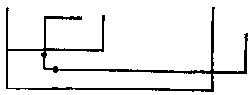
He hath under him 42 Kings, 35 Princes, 28 Dukes, 21 Counsellors,
14 Ministers, 7 Messengers, 29000 legions of Spirits.
|
BETHOR, Quæ Ioui adscribuntur,
gubernat: vocatus citò aduenit.
Quem suo charactere dignatur, ad maximas
dignitates euehit, obiicit thesauros
Aereos conciliat Spiritus, qui vera
dant responsa. De loco ad locum transportant
quesuis res & lapides preciosos,
ac medicinas miraculosas in suis effectibus.
Dat etiam familiares firmamenti,
& potest ad 700 annos vitam prolongare,
si DEVS voluerit.
CHARACTER
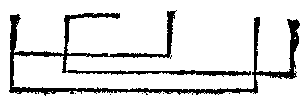
Habet sub se 42 Reges, 35 Principes, 28
Duces, 21 Consiliarios, 14 Ministros,
7 Nuntios, 29000 Legiones Spirituum.
|
Phalec [sic] ruleth those things which are attributed
to Mars, the Prince of peace. He that hath his character
he raiseth to great honours in warlike affaires.
His character.
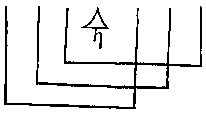
|
PHALEG præest Marti attributis:
Pacis princeps: eius characterem
cui tribuit, euehit ad summas dignitates
in re bellica.
CHARACTER
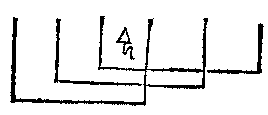
|
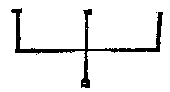
Och governeth solar things; he giveth 600 yeares,
with perfect health; he bestoweth great wisdom, giveth the most
excellent Spirits, teacheth perfect Medicines: he converteth all
things into most pure gold and precious stones: he giveth gold,
and a purse springing with gold. He that is dignified with his
Character, he maketh him to be worshipped as a Deity, by the Kings
of the whole world.
The Character.
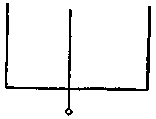
He hath under him 36536 Legions: he administreth all things alone:
and all his spirits serve him by centuries.
|
HOC [sic OCH] Solaribus præest, dat 600 annos
cum firma valetudine. Largitur
Sapientiam: dat spiritus præstantissimos,
docet perfectam medicinam, conuertit
omnia in aurum purissimum & lapides
preciosos. Dat aurum & crumenam
pullulantem auro. Quem suo charactere
dignum duxerit, facit tanquam
numen coli à regibus totius mundi.
CHARACTER
Habet sub se legiones 36536. Solus
administrat omnia, & sibi inseruiunt
omnes sui spiritus per centurias.
|
Hagith governeth Venereous things. He
that is dignified with his Character, he maketh very fair, and
to be adorned with all beauty. He converteth copper into gold,
in a moment, and gold into copper: he giveth Spirits which do
faithfully serve those to whom they are addicted.
His character.

He hath 4000 Legions of Spirits and over every thousand he ordaineth
Kings for their appointed seasons.
|
HAGITH gubernat Venerea, quem
suo dignatur charactere formosissimum
facit, & ornatum omni decore. Cuprum
conuertit in momento in aurum, et contrà
aurum in cuprum. Dat spiritus qui fideliter
inseruiunt iis, quibus addicuntur.
CHARACTER

Habet legiones 4000 Spirituum,
& singulis millenis præficit Reges statis
temporibus.
|
Ophiel is the governour of such things as are
attributed to Mercury: his Character is this.
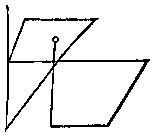
His Spirits are 100000 Legions: he easily giveth Familiar Spirits:
he teacheth all Arts: and he that is dignified with his Character,
he maketh him to be able in a moment to convert Quicksilver into
the Philosophers stone.
|
OPHIEL est gubernator
Mercurialium, eius CHARACTER est talis,
Eius Spiritus accedunt ad legiones centum
millia, dat Spiritus familiares facillimè.
Docet omnes artes: & quem
suo charactere dignatur, facit posse in
momento argentum viuum conuertere
in lapidem Philosophorum.
|
Phul hath this Character.
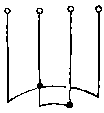
He changeth all metals into silver, in word and deed; governeth
Lunary things; healeth the dropsie: he giveth spirits of the water,
who do serve men in a corporeal and visible form; and maketh men
to live 300 yeers.
|
PHVL hoc gaudet CHARACTERE,
Omnia metalla in argentum commutat
dicto & facto: Gubernat lunaria:
sanat Hydropem: dat aqueos spiritus,
& qui inseruiunt homini corporali &
visibili forma: facit 300 annos
viuere.
|
The most general Precepts of this Secret.
1. Every Governour acteth with all his Spirits, either naturally,
to wit, always after the same maner; or otherwise of their own
free-will, if God hinder them not.
2. Every Governour is able to do all things which are done naturally
in a long time, out of matter before prepared; and also to do
them suddenly, out of matter not before prepared. As Och,
the Prince of Solar things, prepareth gold in the mountains in
a long time; in a less time, by the Chymical Art; and Magically,
in a moment.
3. The true and divine Magician may use all the creatures of God,
and offices of the Governours of the world, at his own will, for
that the Governours of the world are obedient unto them, and come
when they are called, and do execute their commands: but God is
the Author thereof: as Joshua caused the Sun to stand still
in heaven.
|
Generalissima huius secreti præcepta.
1 Gubernator quilibet cum omnib. suis
Spiritibus agit: Aliàs naturaliter, semper
scilicet eodem modo: Aliàs ex libera
volutate sua, si à Deo non impeditur.
2 Potest etiam omnia, quæ naturaliter
longo tempore facit in materia prædisposita,
etiam repentè in materia non
prædisposita facere. Sicut Och
Solarium longo tempore parat aurum
in montibus, Minori tempore per
Chemicam artem: In momento Magicè.
3 Verus & diuinus Magus potest omnibus
creaturis Dei, & gubernatorum
mundi officio vti ad nutum suum.
Ideò illis obediunt mundi Gubernatores,
& VOCATI VENIVNT,
ac i ussa [*iussa] exequuntur, DEO tamen authore,
Sicut Iosue stetit sol in cœlo.
|
They send some of their Spirits to the Mean Magicians, which do
obey them onely in some determinate business: but they hear not
the false Magicians, but expose them to the deceits of the devils,
and cast them into divers dangers, by the Command of God; as the
Prophet Jeremiah testifieth, in his eighth Chapter, concerning
the Jews.
|
Mediocribus Magis, mittunt de suis
Spiritibus, qui in determinatis tantûm
quibusdam negotiis illis obtemperent.
At Pseudomagos non audiunt, sed eos
Dæmonibus illudendos obiiciunt, & in
varia pericula coniiciuntur Deo mandante,
sicut de Iudæis Ieremias capite 8.
testatur.
|
4. In all the elements there are the seven Governours with their
hosts, who do move with the equal motion of the firmament; and
the inferiours do always depend upon the superiours, as it is
taught in Philosophy.
|
4 In omnibus elementis sunt septem
gubernatores cum suis exercitibus, qui
æquali motu cum firmamenti motu
mouentur, ac semper inferiores à superioribus
dependent sicut PHILOSOPHIA GRATIÆ docetur.
|
5. A man that is a true Magician, is brought forth a Magician
from his mothers womb: others, who do give themselves to this
office, are unhappie. This is that which John the Baptist
speaketh of: No man can do any thing of himself, except it
be given him from above.
|
5 Ex vtero matris ad Magiam producitur
homo, qui verus magus esse debet:
alii qui seipsos ad hoc officium ingerunt,
sunt infelices. Hîc locum habet quod
Iohannes Baptista inquit: Nemo potest
sibi accipere quicquam, nisi ei datum
fuerit desuper.
|
6. Every Character given from a Spirit, for what cause soever, hath
his efficacie in this business, for which it is given, in the
time prefixed: But it is to be used the same day and Planetary
hour wherein it is given.
|
6 Omnis CHARACTER à Spiritu
datus quacunque ratione, habet suam
efficaciam in hoc negotio, in quo datus
est, in tempore præfinito. Est autem eo
vtendum hora & die Planetaria qua
datus est.
|
7. God liveth, and thy soul liveth: keep thy Covenant, and thou
hast whatsoever the spirit shall reveal unto thee in God, because
all things shall be done which the Spirit promiseth unto thee.
|
7 Viuit DEVS, & viuit anima tua,
pactum tuum seruaueris, quod cum spiritu
reuelatore in DEO habes, quod omnia
fient, quæ Spiritus tibi promittit.
|
|
Aphor. 18.
There are other names of the Olympick spirits delivered
by others; but they onely are effectual, which are delivered to
any one, by the Spirit the revealer, visible or invisible: and
they are delivered to every one as they are predestinated: therefore
they are called Constellations; and they seldome have any efficacie
above 40 [*140] yeers. Therefore it is most safe for the young practisers
of Art, that they work by the offices of the Spirits alone, without
their names; and if they are pre-ordained to attain the Art of
Magick, the other parts of the Art will offer themselves unto
them of their own accord. Pray therefore for a constant faith,
and God will bring to pass all things in due season.
|
APHORISMVS XVIII.
Olympicorum spirituum nomina ab
aliis alia traduntur, sed tantùm illa sunt
efficacia, quæ vnicuique traduntur per
reuelatorem Spiritum visibilem vel
inuisibilem: & vnicuique traduntur,
prout ipsi sunt prædestinati. Ideo dicuntur
esse constellata, & rarò efficaciam
habent vltra 140 annos. Tutissimum igitur est tyronibus artis, vt
sine nominibus per sola Spirituum officia
operentur, & si ad Magiam præordinati
fuerint, reliqua artis requisita
se vltrò offerent. ORATE TANTVM
PRO FIDE CONSTANTE, & DEVS ordinabit omnia
in tempore oportuno.
|
|
Aphor. 19.
Olympus and the inhabitants thereof, do of their own accord
offer themselves to men in the forms of Spirits, and are ready
to perform their Offices for them, whether they will or not: by
how much the rather will they attend you, if they are desired?
But there do appear also evil Spirits, and destroyers, which is
caused by the envy and malice of the devil; and because men do
allure and draw them unto themselves with their sin, as a punishment
due to sinners. Whosoever therefore desireth familiarly to have
a conversation with Spirits, let him keep himself from enormious
[sic] sins, and diligently pray to the most High to be his keeper;
and he shall break through all the snares and impediments of the
devil: and let him apply himself to the service of God, and he
will give him an increase in wisdom.
|
APHOR. XIX.
Olympus & eius incolæ informa Spirituum
se vltrò hominibus offerunt, &
sua officia illis etiam inuitis præstant,
quantò magis si eos expetas aderunt.
Quod autem etiam mali accedunt, et euersores,
fit ex inuidia Diaboli, et quòd
peccatis suis homines eos ad se alliciunt
tanquam peccatores debitam pœnam. Qui
igitur expetit familiariter conuersari
cum spiritibus, se custodiat ab enormibus
peccatis, & diligenter oret pro
custodia altissimi, & prærumpet per
diaboli insidias ac eius impedimenta.
Imo ipsemet ad utiliter inseruiendum
Mago, à DEO illi mandabitur &
adigetur.
|
|
Aphor 20.
All things are possible to them that believe them, and are willing
to receive them; but to the incredulous and unwilling, all things
are unpossible [sic]: there is no greater hinderance then a wavering
minde, levity, unconstancy, foolish babbling, drunkenness, lusts,
and disobedience to the word of God. A Magician therefore ought
to be a man that is godly, honest, constant in his words and deeds,
having a firm faith toward God, prudent, and covetous of nothing
but of wisdom about divine things.
|
APHORIS. XX.
Omnia possibilia sunt credenti & volenti:
Omnia impossibilia sunt incredulo
& nolenti: Nihil magis impedit,
quàm animi volubilitas, leuitas, inconstantia,
futilitas, ebrietates, libidines,
inobedientia erga verbum DEI. Magum
ergo oportet esse virum pium, probum,
constantem in dictis & factis,
firma fide in DEVM, prudentem, &
nullius rei auarum præterquàm sapientiæ,
quæ est circa res diuinas.
|
|
Aphor. 21.
When you would call any of the Olympick Spirits, observe
the rising of the Sun that day, and of what nature the Spirit
is which you desire; and saying the prayer following, your desires
shall be perfected.
|
APHORIS. XXI.
Olympicos Spiritus cùm euocare volueris,
obserua ortum Solis diei, de cuius
natura spiritum desyderas, & dicta sequenti
oratione fies voti compos.
|
Omnipotent and eternal God, who hast ordained the whole creation
for thy praise and glory, and for the salvation of man, I beseech
thee that thou wouldst send thy Spirit N.N. of the solar order,
who shall inform and teach me those things which I shall ask of
him; or, that he may bring me medicine against the dropsie, &c.
Nevertheless not my will be done, but thine, through Jesus Christ
thy onely begotten Son, our Lord. Amen.
|
OMNIPOTENS ÆTERNE
DEVS, qui totam Creaturam
condidisti in laudem tuam, & honorem
tuum, ac ministerium hominis, oro vt
SPIRITVM: N.N. de Solari ordine
mittas, qui me informet & doceat,
quæ illum interrogauero: Aut mihi medicinam
adferat contra hydropem, &c.
Verùm non mea fiat voluntas, sed tua
per IESVM CHRISTVM filium
tuum vnigenitum DOMINVM
NOSTRVM. Amen.
|
Invocation of the spirit.
|
But thou shalt not detain the Spirit above a full hour, unless
he be familiarly addicted unto thee.
|
Sed vltra horam integram non defatiges
Spiritum, nisi sit tibi familiariter
addictus.
|
Forasmuch as thou camest in peace, and quietly, and hast answered
unto my petitions; I give thanks unto God, in whole Name thou
camest: and now thou mayest depart in peace unto thy orders; and
return to me again when I shall call thee by thy name, or by thy
order, or by thy office, which is granted from the Creator.
Amen.
Ecclesiast. Chap. 5. Be not rash with thy mouth, neither let
thy heart be hasty to utter any thing before God; for God is in
Heaven, and thou in earth: Therefore let thy words be few; for
a dream cometh through the multitude of business.
|
QVIA PLACIDE ET
QVIETE VENISTI, ac petitioni
meæ respondisti, ago DEO gratias
in cuius venisti nomine, ac eas nunc in
pace ad ordines tuos, rediturus ad me
cum te vocauero nomine tuo, aut per ordinem,
aut per officium tuum, quod à Creatore
concessum est. Amen.
|
Dismissal of the spirit.
Note the quote from Ecclesiastes does not occur in the Latin edition, but appears
to have been added (along with some minor corrections as well as a few errors) in Agrippa's Opera
(1579). Since it can also be found in Sloane ms. 3851 and Marc Haven's French translation, it is evident
that those editions drew on the Agrippa edition rather than the original text.
|
The third [fourth] Septenary.
Aphor. 22.
We call that a secret, which no man can attain unto by humane
industry without revelation; which Science lieth obscured, hidden
by God in the creature; which nevertheless he doth permit to be
revealed by Spirits, to a due use of the thing it self. And these
secrets are either concerning things divine, natural or humane.
But thou mayst examine a few, and the most select, which thou
wilt commend with many more.
|
SEPTENA TERTIA [Quarta].
APHOR. XXII.
Secretum id dicimus, quod industria
humana sine reuelatione nemo exquisiuerit,
cuius scientia latet in creatura
à Deo occulta, quod tamen permittit
Spiritibus reuelari ad debitum eius rei
vsum: & sunt secreta, vel de rebus diuinis,
vel naturalibus, vel humanis. Exquiras
autem pauca & selectissima,
quibus pluribus commodaueris.
|
|
Aphor. 23.
Make a beginning of the nature of the secret, either by a Spirit
in the form of a person, or by vertues separate, either in humane
Organs, or by what manner soever the same may be effected; and
this being known, require of a Spirit which knoweth that art,
that he would briefly declare unto thee whatsoever that secret
is: and pray unto God, that he would inspire thee with his grace,
whereby thou maist bring the secret to the end thou desireth,
for the praise and glory of God, and the profit of thy neighbour.
|
APHORISMVS XXIII.
Initiò constitue de natura illius secreti,
an per spiritus in forma personæ, an
per virtutes separatas, an organis humanis,
aut quomodocunque perfici queat,
nec ne. Hoc depræhenso, require à Spiritu,
qui eam scit artem, vel quicquid
est secreti, vt breuiter tibi illud dictet.
Et ora DEVM, vt tibi suam gratiam
adspiret, quò ad optatum finem secretum
deductas in laudem & honorem
DEI, ac proximi vtilitatem.
|
|
Aphor. 24.
The greatest secrets are number seven.
1. The first is the curing of all diseases in the space of seven
dayes, either by character, or by natural things, or by the superior
Spirits with the divine assistance.
2. The second is, to be able to prolong life to whatsoever age
we please: I say, a corporal and natural life.
3. The third is, to have the obedience of the creatures in the
elements which are in the forms of personal Spirits; also of Pigmies,*
Sagani, Nymphes, Dryades, and Spirits of the woods.
[* Spirits of the four elements. Paracels.]
4. The fourth is, to be able to discourse with knowledge and understanding
of all things visible and invisible, and to understand the power
of every thing, and to what it belongeth.
5. The fifth is, that a man be able to govern himself according
to that end for which God hath appointed him.
6. The sixth is, to know God, and Christ, and his holy Spirit:
this is the perfection of the Microcosmus.
7. The seventh, to be regenerate, as Henochius the King
of the inferiour world.
These seven secrets a man of an honest and constant minde may
learn of the Spirits, without any offence unto God.
|
APHOR. XXIIII.
Maxima secreta sunt numero septem.
Primum, Est omnium morborum
curatio, spatio septem dierum, vel per
characteres, vel per naturalia, vel per
superiores Spiritus cum diuino auxilio.
Secundum est, vitam posse ad placitum
producere ad quamcunque ætatem,
vitam inquam corpoream & naturalem.
Hanc primi habuêre parentes.
Tertium, Habere obedientiam creaturarum
in Elementis, quæ sunt in
forma Spirituum personalium: item
Pigmeorum, Saganarum, Nympharum,
Driadum, Syluaticorum hominum.
Quartum, Posse colloqui cum intelligentiis
omnium rerum visibilium, &
inuisibilium, ac de quauis re audire, ad
quid cui præest, conferat.
Quintum, Seipsum posse gubernare
ad finem à Deo sibi præfixum.
Sextum, Nosse Deum & Christum,
eiúsue spiritum Sanctum. Hæc est perfectio
Microcosmi.
Septimum, Regenerari vt sit Henochii
rex inferioris mundi.
Septem hæc secreta sine DEI
offensione homo didicerit à
Spiritibus, qui fuerit honesti
& constantis animi.
|
|
The mean Secrets are likewise seven in number.
1. The first is, the transmutation of Metals, which is vulgarly
called Alchymy; which certainly is given to very few, and
not but of special grace.
2. The second is, the curing of diseases with Metals, either by
the magnetick vertues of precious stones, or by the use of the
Philosophers stone, and the like.
3. The third is, to be able to perform Astronomical and Mathematical
miracles, such as are Hydraulick-engines, to administer
business by the influence of Heaven, and things which are of the
like sort.
4. The fourth is, to perform the works of natural Magick, of what
sort soever they be.
5. The fifth is, to know all Physical secrets.
6. The sixth is, to know the foundation of all Arts which are
exercised with the hands and offices of the body.
7. The seventh is, to know the foundation of all Arts which are
exercised by the angelical nature of man.
|
SECRETA MEDIO-
cria similiter Septem sunt
numero.
1 Metallorum transmutatio, quæ vulgò
Alchimia dicitur, certa quidem, sed
paucissimis datur, & non nisi ex peculiari
gratia. Non est currentis neque volentis,
sed miserentis Dei.
2 Metallica morborum cura, aut per
magnalia lapidum pretiosorum, aut lapidis
philosophici & similium vsu.
3 Posse astronomica & mathematica
præstare miracula, sicut sunt machinæ
hydraulicæ, administrare negotia pro
cœli influxu, & si quæ sunt similia.
4 Naturalis Magiæ opera, qualiacunque
illa sunt exhibere.
5 Omnes Phisicas præuisiones scire.
6 Omnes artes ex fundamento cognoscere,
quæ manibus exercentur, & corporis
muniis.
7 Omnes artes ex fundamento cognoscere,
quæ per Angelicam hominis naturam
exercentur.
|
|
The lesser secrets are seven.
1. The first is, to do a thing diligently, and to gather together
much money.
2. The second is, to ascend from a mean state to dignities and
honours, and to establish a newer family, which may be illustrious
and do great things.
3. The third is, to excel in military affairs, and happily to
achieve to great things, and to be an head of the head of Kings
and Princes.
4. To be a good house-keeper both in the Country and City.
5. The fifth is, to be an industrious and fortunate Merchant.
6. To be a Philosopher, Mathematician, and Physician, according
to Aristotle, Plato, Ptolomy, Euclides, Hippocrates, and
Galen.
7. To be a Divine according to the Bible and Schooles, which all
writers of divinity both old and new have taught.
|
Secreta minora sunt septem.
1 Rem grauiter facere, & multum pecuniæ corradere.
2 De humili statu ad dignitates & honores
ascendere, ac nouam familiam
fundare, quæ sit illustris & magnas
res gerat.
3 In re militari excellere, & res magnas
feliciter gerere, & esse capitis caput:
Regum ac principum.
4 Esse bonum patrem familias ruri &
in vrbe.
5 Esse mercatorem industrium & fortunatum.
6 Esse Philosophum, Mathematicum,
Medicum, Aristotelicum, Platonicum,
Ptolæmaicum, Euclideum, Hippocraticum,
Galenicum.
7 Esse Theologicum, Biblicum, Scholasticum,
qui omnes scriptores Theologiae,
veteres & nouos didicerit.
|
|
Aphor. 25.
We have already declared what a secret is, the kindes and species
thereof: it remaineth now to shew how we may attain to know those
things which we desire.
The true and onely way to all secrets, is to have recourse unto
God the Author of all good; and as Christ teacheth, In the
first place seek ye the kingdom of God and his righteousness,
and all these things shall be added unto you. [Matt. 6.33]
2. Also see that your hearts be not burthened with surfeting,
and drunkenness, and the cares of this life.
3. Also commit your cares unto the Lord, and he will do it.
4. Also I the Lord thy God do teach thee, what things are profitable
for thee, and do guide thee in the way wherein thou walkest. [Is. 48.17]
|
APHOR. XXV.
Dictum est quid sit secretum, quæ
genera, quæ species. Nunc restat dicere,
quomodo ea quæ desideramus scire, assequamur.
Vnica & vera via ad omnia
secreta est, vt recurras ad Deum omnis
boni authorem, & sicut Christus docet.
Primò quæras regnum Dei & iustitiam
eius, & cætera adiicientur vobis.
2 Item, Cauete ne corda vestra grauentur
crapula & ebrietate & curis
huius vitæ.
3 Item Commendes curas Domino, &
ipse faciet.
4 Item, Ego Dominus Deus tuus, docens
te vtilia, gubernans te in via qua
ambulas.
|
5. And I will give thee understanding, and will teach thee
in the way wherein thou shalt go, and I will guide thee with my
eye.
|
5 Et intellectum tibi dabo, & docebo
te in via quam gradieris, oculo meo te
regam.
|
[Compare Ps. 31.8.]
|
6. Also if you which are evil, know how to give good things
to your children, how much more shall your Father which is in
heaven give his holy Spirit to them that ask him?*
|
6 Item vos qui mali estis, scitis dare
bona filiis vestris: Quantò magis pater
vester, qui est in cœlis, dabit Spiritum
sanctum petentibus.
|
[Compare Mat. 7.11.]
|
7. If you will do the will of my Father which is in heaven,
ye are truly my disciples, and we will come unto you, and make
our abode with you.*
|
7 Item, Si volueritis facere voluntatem
patris mei, qui in cœlis est, verè
discipuli mei estis, & veniemus ad vos, &
mansionem apud vos faciemus.
|
[Compare John 14.23.]
|
If you draw these seven places of Scripture from the letter unto
the Spirit, or into action, thou canst out erre, but shalt attain
to the desired bound; thou shalt not erre from the mark, and God
himself by his holy Spirit will teach thee true and profitable
things: he will give also his ministring Angels unto thee, to
be thy companions, helpers, and teachers of all the secrets of
the world, and he will command every creature to be obedient unto
thee, so that cheerfully rejoycing thou maist say with the Apostles,
That the Spirits are obedient unto thee; so that at length thou
shalt be certain of the greatest thing of all, That thy name is
written in Heaven.
|
Septem hæc scripturæ loca, si de litera
ad spiritum seu in actum deduxeris
errare non poteris, quin desideratam
metam attingas, à scopo non aberrabis
& ipse DEVS per Spiritum Sanctum
suum te docebit vtilia & vera
dabit etiam tibi ministros angelos suos,
tuos comites, doctores et adiutores, ad omne
secretum mundi. Mandabit et omni
creaturæ, vt tibi obediat, vt lætus &
gaudens dicas cum Apostolis, tibi obedire
Spiritus. Tandem quod maximum
est, certus eris, nomen tuum scriptum
esse in cœlis.
|
|
Aphor. 26.
There is another way which is more common, that secrets may be
revealed unto thee also, when thou art unwitting thereof, either
by God, or by Spirits which have secrets in their power; or by
dreams, or by strong imaginations and impressions, or by the constellation
of a nativity by celestial knowledge. After this manner are made
heroick men, such as there are very many, and all learned men
in the world, Plato, Aristotle, Hippocrates, Galen, Euclides,
Archimedes, Hermes Trismegistus the father secrets, with Theophrastus,
Paracelsus; all which men had in themselves all the vertues
of secrets. Hitherto also are referred, Homer, Hesiod, Orpheus,
Pytagoras; but these had not such gifts of secrets as the
former. To this are referred, the Nymphes, and sons of Melusina [Melusine],
and Gods of the Gentiles, Achilles, Æneas, Hercules:
also, Cyrus, Alexander the great, Julius Cæsar,
Lucullus, Sylla. Marius.
|
APHOR. XXVI.
Alia via est communior, vt tibi
reuelentur, etiam te inscio, secreta à
Deo vel Spiritibus, qui secretum in sua
potestate habent, vel per Somnia, vel
per fortes imaginationes seu impressiones.
Aut ex natiuitatis constellatione,
per cœlestes intelligentias. Hoc modo
fiunt viri heroici, sicut sunt plerique
omnes docti viri in hoc mundo PLATO,
ARISTOTELES, HIPPOCRATES, Galenus, Euclides, Archimedes,
HERMES TRISMEGISTVS EST SECRETORVM
PATER CVM THEOPHRASTO PARACELSO
& in se omnes vires habent secretorum.
Ad hoc secretum Homerus, Hesiodus,
Orpheus, Pytagoras, referendi
sunt, temetsi [*tametsi] hi nonnihil præcedentis
secreti dona habuêre. Huc referuntur
Nymphidici, sicut Melisinæ filii &
diis geniti Achilles, Æneas, Hercules,
item, Cyrus, Alexander Magnus, Iulii
Cæsar, Lucullus, Sylla, Marius.
|
It is a canon, That every one know his own Angel. and that he
obey him according to the word of God; and let him beware of the
snares of the evil Angel, lest he be involved in the calamities
of Brute [Brutus] and Marcus Antonius [Mark Antony]. To this refer the
book of Jovianus Pontanus of Fortune, and his Eutichus.
|
CANON est, vt vnusquisque noscat
suum genium, & vt illi obtemperet
iuxta verbum Dei: ac caueat insidias
mali genii, ne Bruti & M. Antonii
calamitatibus inuoluatur. Huc refer
IOVIANI Pontani librum de fortuna
& suo Euticho.
|
Giovanni Pontano (1426-1503)
|
The third way is, diligent and hard labor, without which no great
thing can be obtained from the divine Deity worthy admiration,
as it is said,
|
TERTIA VIA est improbus
labor, quo sine aliquo diuino numine
nihil magni aut admiratione dignum
aliquis assequitur, sicut dicitur:
|
Tu nihil invita dices faciésve Minerva.
Nothing canst thou do or say against Minerva's will.
|
Tu nihil inuita dices faciésve
Minerua.
|
[Horace, Ars Poetica 385.]
|
We do detest all evil Magicians, who make themselves associates
with the devils with their unlawful superstitions, and do obtain
and effect some things which God permitteth to be done, instead
of the punishment of the devils. So also they do other evil acts,
the devil being the author, as the Scripture testifie of Judas.
To these are referred all idolaters of old, and of our age, and
abusers of Fortune, such as the heathens are full of. And to these
do appertain all Charontick evocation of Spirits the works of
Saul with the woman, and Lucanus prophesie of the
deceased souldier, concerning the event of the Pharsalian war,
and the like.
|
Detestamur omnes Cacomagos, qui
illicitis superstitionibus se socios dæmoniorum
faciunt, et quædam quæ DEVS
fieri permittet, loco pœnæ à Diabolis
impetrant. Sicut etiam alia fiunt mala
Diabolo authore, veluti de IVDA
testatur scriptura. Huc referuntur
omnes Idolomaniæ veterum & nostræ
ætatis, ac sortium abussus, qualia multa
habuit gentilitas. Huc etiam pertinet
CHARONTICA euocatio manium, veluti SAVLIS
cum MVLIERE OPVS & LVCIANI defuncti militis
VATICINIVM de
euentu pugnæ Parsalicæ, & si quæ sunt
similia.
|
|
Aphor. 27.
Make a Circle with a center A, which is B. C. D. E. At the East
let there be B.C. a square. At the North, C.D. At the West, D.E.
And at the South, E.D. [*E.B.] Divide the Several quadrants into seven
parts, that there may be in the whole 28 parts: and let them be
again divided into four parts, that there may be 112 parts of
the Circle: and so many are the true secrets to be revealed. And
this Circle in this manner divided, is the seal of the secrets
of the world, which they draw from the onely center A, that is,
from the invisible God, unto the whole creature. The Prince of
the Oriental secrets is resident in the middle, and hath three
Nobles on either side, every one whereof hath four under him,
and the Prince himself hath four appertaining unto him. And in
this manner the other Princes and Nobles have their quadrants
of secrets, with their four secrets.
|
APHORISMVS
XXVII.
FAC CIRCVLVM CENTRO A,
qui sit B.C.D.E. Ad artum sit
B.C. quadrum ad Septentrionem C.D.
ad Occasum D.E. & ad Meridiem E.B.
Singulos quadrantes diuide in septem
partes, vt sint in vniuersum 28 partes.
Et partes rursum in quatuor diuidantur,
ut sint 112 circuli partes, ac tot sunt
Secreta vera reuelanda. Estque hic CIRCVLVS
hoc modo diuisus SIGILLVM SECRETORVM totius
mundi, quæ ab vnico. A centro promanant,
hoc est ab indiuisibili Deo in vniuersam
creaturam. PRINCEPS
ORIENTALIVM SECRETORVM
residet in medio, & habet
vtrinque ternos satrapas, quorum sub
se quilibet habet quatuor, & ipse Princeps
sibi quatuor retinuit. Hoc modo
& reliqui quadrantes suos secretorum
Principes & Satrapas cum quaternis
suis scriptis habent.
|
* Note the typographical error in Turner's edition
makes the description incomprehensible.
Sl. 3851 correctly reads "E.B. in the South." It also gives the
diagram shown here, which does not occur in either Turner or the
1575 edition.
|
But the Oriental [Eastern] secret is
the study of all wisdom; The West, of strength; The South, of
tillage; The North, of more rigid life. So that the Eastern secrets
are commended to be the best; the Meridian [Southern] to be mean; and the
West** and North to be lesser.
|
Sed ORIENTIS
est omnis Sapientiæ studium. OCCASVS
roboris, MERIDIEI culturæ,
SEPTENTRIONIS rigidioris
vitæ. Orienti igitur MAXIMA commendata
sunt SECRETA Meridiei
MEDIOCRIA. Occasui & Septentrioni
MINORA.
|
* Sl. 3851 reads: But the Study of all wisdome is in the East.
The West is for force and strength.
The South is for Culture and Husbardry [sic].
The North for a Rigged and hard life.
** Turner mistakenly reads "East."
|
The use of this seal of secrets is,
that thereby thou maist know whence the Spirits or Angels are
produced,* which may teach the secrets delivered unto them from
God. But they have names taken from their offices and powers,
according to the gift which God hath severally distributed to
every one of them. One hath the power of the sword; another, of
the pestilence; and another, of inflicting famine upon the people,
as it is ordained by God. Some are destroyers of Cities, as those
two were, who were sent to overthrow Sodom and Gomorrha,
and the places adjacent, examples whereof the holy Scripture witnesseth.
Some are the watch-men over Kingdoms; others the keepers of private
persons; and from thence, anyone may easily form their names in
his own language: so that he which will, may ask a physical Angel,
mathematical, or philosophical, or an Angel of civil wisdom, or
of supernatural or natural wisdom, or for any thing whatsoever;
and let him ask seriously, with a great desire of his minde, and
with faith and constancy and without doubt, that which he asketh
he shall receive from the Father and God of all Spirits. This
faith surmounteth all seals, and bringeth them into subjection
to the will of man. The Characteristical maner of calling Angels
succeedeth this faith, which dependeth onely on divine revelation;
But without the said faith preceding it, it lieth in obscurity.
Nevertheless, if any one will use them for a memorial, and not
otherwise, and as a thing simply created by God to his purpose,
to which such a spiritual power or essence is bound; he may
use
them without any offence unto God. But let him beware, lest that
he fall into idolatry, and the snares of the devil, who with his
cunning sorceries, easily deceiveth the unwary. And he is not
taken but onely by the finger of God, and is appointed to the
service of man; so that they unwillingly serve the godly; but
not without temptations and tribulations, because the commandment
hath it, That he shall bruise the heel of Christ, the seed of
the woman. We are therefore to exercise our selves about spiritual
things, with fear and trembling, and with great reverence towards
God, and to be conversant in spiritual essences with gravity and
justice. And he which medleth with such things, let him beware
of all levity, pride, covetousness, vanity, envy and ungodliness,
unless he wil miserably perish.
|
VSVS huius
secretorum sigilli est, vt scias vnde producantur
Spiritus seu Angeli, qui secreta
sibi à Deo tradita doceant. Nomina
autem habent desumpta ab officiis &
virtutibus, prout Deus unicuique suum
munus distribuit. Alius habet potestatem
gladii, alius pestis, alius famis infligendæ
populis, prout à Deo ordinatum
fuerit. Alii sunt euersores vrbium, sicut
illi duo, qui missi erant ad euertendum
Sodomam & Gomorrham, ac vicina
loca: quemadmodum horum exempla
testatur Scriptura sacra. Alii sunt
vigiles regnorum, alii custodes priuatorum,
proinde unusquisque sibi facile eorum
FORMAVERIT NOMINA
in sua lingua. Ita qui voluerit petat
Angelum Medicum aut Philosophicum,
aut Mathematicum, aut Angelum
prudentiæ ciuilis, Sapientiæ supernaturalis,
vel naturalis, aut qualemcunque
& PETAT SERIO, maximo
animi motu, FIDE et CONSTANTIA,
ac sine dubio quod petet, accipiet
à Patre omnium Spirituum Deo. Hæc
FIDES superat omnia sigilla, & subiicit
illos voluntati hominis. Huic FIDEI
succedit CHARACTERISTICA
euocandi Angelos ratio, quæ
sola ex reuelatione diuina dependet: sed
sine fide tamen prædicta, eaque pracedente [*præcedente]
iacet in obscuro. Si quis tamen iis non
aliter atque memoriali uti voluerit, &
veluti simplici aliquo à Deo ad hoc creato,
cui talis virtus seu Spiritualis essentia
alligata sit: poterit sine Dei offensa
iis uti. Sed caueat, ne in Idololatriam
cadat ac Diaboli laqueos, qui suæ venationi
intentus facilè INCAVTOS
decipit. Et ipse non nisi solo
digito Dei capitur, ac seruituti hominis
addicitur, vt pio etiam inuiti seruiant.
Verum non sine TENTATIONIBVS
& tribulationibus, si quidem
mandatum habet, vt insidietur
calcanei CHRISTI ser semini mulieris.
CVM METV igitur &
tremore versandum in Pneumatica, ac
summa erga Deum reuerentia, & cum
GRAVITATE & IVSTITIA
cum spiritualibus essentiis CONVERSANDVM.
Ac ab omni leuitate,
superbia, auaricia, vanitate, inuidia,
impietate sibi caueat, qui
talia tractat, nisi miserabiliter perire
velit.
|
* Produced: i.e. revealed.
|
|
|
|
Aphor. 28.
Because all good is from God, who is
onely good, those things which we would obtain of him, we ought
to seek them by prayer in Spirit and Truth, and a simple heart.
The conclusion of the secret of secrets is, That every one exercise
himself in prayer, for those things which he desires, and he shall
not suffer a repulse. Let not any one despise prayer; for by whom
God is prayed unto, to him he both can and will give. Now let
us acknowledge him the Author, from whom let us humbly seek for
our desires. A merciful & good Father, loveth the sons of
desires, as Daniel; and sooner heareth us, then we are
able to overcome the hardness of our hearts to pray. But he will
not that we give holy things to dogs, nor despise and condemn
the gifts of his treasury. Therefore diligently and often read
over and over the first Septenary of secrets, and guide and direct
thy life and all thy thoughts according to those precepts; and
all things shall yield to the desires of thy minde in the Lord,
to whom thou trustest.
|
XXVIII.
Quia omne bonum à Deo, solo bono,
à quo quæ volumus impetrare, oportet
in Spiritu & veritate ac simplici corde
orando. CONCLVSIO secreti secretorum
est, vt se quisque excitet ad orandum
pro eo, quod quis desiderat, & non
patietur repulsam. Non despiciat aliquis
orationem suam: nam à quo petitur
DEVS, & largiri potest, & largiri
vult, modò agnoscamus authorem, à
quo suppliciter petamus desideria nostra.
Clemens & bonus Pater amat filios
desideriorum, sicut Danielem, & citius
exaudit, quàm nos euincere possimus
duriciem cordis nostri ad orandum.
Sed non vult, vt demus Sanctum canibus,
non vult esse despectum & contemptum
clenidiorum [A: cleinodiorum] thesauri sui. Ergo diligenter
et sæpe legas ac relegas primam
septenam secretorum. Ac vitam omnesque
cogitationes tuas instituas ac dirigas ad
eas præceptiones, et omnia tibi ex animi
tui sententia cedent in domino, cui confidis.
|
The Fifth Septenary
Aphor. 29.
As our study of Magick proceedeth in
order from general Rules premised, let us now come to a particular
explication thereof. Spirits either are divine ministers of the
word, and of the Church, and the members thereof ; or else they
are servient to the Creatures in corporal things, partly for the
salvation of the soul and body, and partly for its destruction.
And there is nothing done, whether good or evil, without a certain
and determinate order and government. He that seeketh after a
good end, let him follow it; and he that desires an evil end,
pursueth that also, and that earnestly, from divine punishment,
and turning away from the divine will. Therefore let every one
compare his ends with the word of God, and as a touchstone that
will judge between good and evil; and let him propose unto himself
what is to be avoided, and what is to be sought after; and that
which he constituteth and determineth unto himself, let him diligently,
not procrastinating or delaying, until he attain to his appointed
bound.
|
SEPTENA
Quinta.
APHOR. XXIX.
Ut Magiæ nostrum studium procedat
ordine, generalibus præceptis præmissis
ad particularem accedamus explicationem:
SPIRITVS aut sunt Diuini
ministri verbi & ecclesiæ ac membrorum
eius: AUT sunt inseruientes creaturæ
in rebus corporalibus, partim ad salutem
corporis & animi, partim ad interitum:
nihilque siue boni siue mali fit
sine certo & determinato ordine ac gubernatione.
Qui bonum finem desiderat
eum consequetur. Qui malum etiam
illum assequetur, idque citissimè ex pœna
diuina & auersione à diuina voluntate.
Proinde unusquisque suos scopos
cum verbo Dei conferat, ac veluti ad lidium
lapidem diiudicet inter bonum &
malum: & apud se constituat quid fugiendum
quidue expetendum sit, quodque
apud se constituerit seu definiuerit, sequatur
grauiter NON PROCRASTINANDO, vt destinatam pertingat
metam.
|
|
Aphor. 30.
They which desire riches, glory of this
world, Magistracy, honours, dignities, tyrannies, (and that magically)
if they endeavour diligently after them, they shall obtain them,
every one according to his destiny, industry, and magical Sciences,
as the History of Melesina [Melusine] witnesseth, and the Magicians
thereof, who ordained, That none of the Italian nation should
for ever obtain the Rule or Kingdom of Naples; and brought it
to pass, that he who reigned in his age, to be thrown down from
his seat: so great is the power of the guardian or tutelar Angels
of Kingdoms of the world.
|
XXX.
QVI diuitias, splendorem huius vitæ,
Magistratus, honores, dignitates,
Tyrannides appetunt (idque Magicè)
SI ANNITANTVR sedulò, assequentur
eos. Vnusquisque pro suo fato
& industria, ac scientia Magica. Sicut
MELESINÆ historia testatur.
ET illius Magi, qui constituit, vt nullus
natione Italus in æternum Neapoli
Tyrannidem seu regnum obtineret:
ac effecit, vt ille qui ipsius ætate regnabat,
de sede deturbaretur. Vsque adeò est
magna potestas vigilum seu tutelarium
Angelorum regnorum mundi.
|
|
Aphor. 31.
Call the Prince of the Kingdom, and lay a command upon
him, and command what thou wilt, and it shall be done, if that
Prince be not again absolved from his obedience by a succeeding
Magician. Therefore the Kingdom of Naples may be again
restored to the Italians, if any Magician shall call him who instituted
this order, and compel him to recal his deed; he may be compelled also,
to restore the secret powers taken from the treasury
of Magick; A Book, a Gemme, and magical Horn,
which being had, any one may easily, if he will, make himself
the Monarch of the world. But Judæus chused rather
to live among Gods, until the judgement, before the transitory good
of this world; and his heart is so blinde, that he understandeth
nothing of the God of heaven and earth, or thinketh
more, but enjoyeth the delights of things immortal, to
his own eternal destruction. And he may be easier called
up, then the Angel of Plotinus in the Temple of Isis.
|
XXXI.
PRINCIPEM REGNI euocato,
& ius in eum impetrato, &
commenda quod volueris, & erit, quousque
ille princeps rursus non fuerit absolutus
ab obedientia per Magum succedentem.
Proinde rursus Neapoli regnum
posset restitui Italis, si quis Magus
euocaret illum, qui hunc ordinem
instituit, & eum adigeret ad recantandum
suum factum. Cogeretur etiam
restituere cleinodia ex Magico Thesauro
ablata, LIBRVM, GEMMAM,
et CORNV MAGICVM
quib. habitis facilè si quis vellet se mundi
monarcham instituerit. Sed ille IVDÆVS elegit viuere inter Deos vsque
ad iudicium præ huius mundi transitoriis
bonis: estque cor eius excœcatum, quod
de Deo Cœli & terræ nihil intelligit,
aut cogitat amplius, sed immortalium
deliciis fruitur in æternam suam perniciem.
Et facilius euocaretur quam PLOTINI
GENIVS in Isidis Templo.
|
|
Aphor. 32.
In like manner also, the Romans were taught by the Sibyls
books; and by that means made themselves the Lords of
the world, as Histories witness. But the Lords of the Prince
of a Kingdom do bestow the lesser Magistracies. He therefore
that desireth to have a lesser office, or dignity, let him
magically call a Noble of the Prince, and his desire shall be
fulfilled.
|
XXXII.
Similiter & Romani ex Sibillinis libris
edocti, simili ratione se mundi dominos
instituerunt, sicut testantur hystoriæ,
Sed MINORES MAGISTRATVS
largiuntur Principis
regni Satrapæ. Qui igitur Minori officio
seu dignitati inhiet, Magicè Satrapam
Principis euocet, & erit voti
compos.
|
|
Aphor. 33.
But he who coveteth contemptible dignities, as riches alone,
let him call the Prince of riches, or one of his Lords,
and he shall obtain his desire in that kinde, whereby he
would grow rich, either in earthly goods, or merchandize,
or with the gifts of Princes, or by the study of Metals, or Chymistry:
as he produceth any president of growing rich by
these means, he shall obtain his desire therein.
|
XXXIII.
At qui spretis dignitatibus, solis inhiat
diuitiis, euocet Diuitiarum Principem,
vel unum de suis Satrapis, & voti
fiet compos, in eo genere, quo voluerit
ditescere, vel bonis terrestribus, vel mercatura,
vel donis principum, vel studio
Metallico, vel Chimicè, prout aliquem
his ditescendi modis præsidem produxerit,
& ius in illum obtinuerit.
|
|
Aphor. 34.
All manner of evocation is of the same kinde and form,
and this way was familiar of old time to the Sibyls and chief
Priests. This in our time, through ignorance and impiety, is
totally lost; and that which remaineth, is depraved with infinite
lyes and superstitions.
|
XXXIIII.
Omnis euocatio est unius generis &
formæ, fuitque olim Sybillis & summis
sacerdotibus familiaris hæc ratio. Hoc
nostro tempore per inscitiam & impietatem
est in vniuersum amissa: quod etiam
restat, est deprauatum superstitionibus
& mendaciis infinitis.
|
|
Aphor. 35.
The humane understanding is the onely effecter of all
wonderful works, so that it be joyned to any Spirit; and
being joyned, she produceth what she will. Therefore we
are carefully to proceed in Magick, lest that Syrens and other
monsters deceive us, which likewise do desire the society of
the humane soul. Let the Magician carefully hide himself
alwaies under the wings of the most High, lest he offer
himself to be devoured of the roaring Lion; for they who
desire earthly things, do very hardly escape the snares of the
devil.
|
XXXV.
MENS HVMANA est SOLA
mirificorum operum effectrix, adeò
ut se iunxerit cui spiritui voluerit.
Coniuncta producit quæ vult: ideò
CAVTE in MAGICIS procedendum,
ne decipiant Syrenes & Monstra,
quæ similiter MENTIS HVMANÆ
societatem appetunt. Semper
igitur lateat sub ALIS ALTISSIMI,
ne se Leoni rugienti deuorandum
offerat. Qui namque mundana
appetunt, difficulter Sathanæ
laqueos effugiunt.
|
The sixth Septenary.
Aphor. 36.
Care is to be taken, that experiments be not mixed with
experiments; but that every one be onely simple and several:
for God and Nature have ordained all things to a certain and
appointed end: so that for examples sake, they who perform
cures with the most simple herbs and roots, do cure
the most happily of all. And in this manner, in Constellations,
Words and Characters, Stones, and such like, do lie hid
the greatest influences or vertues in deed, which are in
stead of a miracle.
So also are words, which being pronounced, do forthwith
cause creatures both visible and invisible to yield obedience,
aswel creatures of this our world, as of the watry, aëry,
subterranean, and Olympick supercelestial and infernal, and also
the divine.
Therefore simplicity is chiefly to be studied, and the
knowledge of such simples is to be sought for from God;
otherwise by no other means or experience they can be found
out.
|
SEPTENA
Sexta.
APHORIS. XXXVI.
CAVENDVM est, ne experimenta
experimentis commisceantur,
sed vt unumquodque sit simplex duntaxat
& unum. Nam DEVS & NATVRA
singula ad certum & destinatum
finem ordinarunt. Ita, EXEMPLI
GRATIA, qui simplicissimis
herbis & radicibus curant, omnium felicissimè
curant. Hoc modo & in constellatis
vocabulis & characteribus, lapidibus
& similibus maximæ latent
influentiæ seu virtutes in actu, quæ
sunt miraculi loco.
Ita sunt & dictiones, quæ pronunciatæ
statim exhibent obedientes creaturas
visibiles et inuisibiles tam de nostro hoc
mundo, quàm de Aqueo, Aereo, Subterraneo
& Olympico, Supercœlesti, Infernali,
& tandem etiam diuino.
Studendum igitur maximè simplicitati,
& à Deo impetranda notitia talium
simplicium: alias nulla alia ratione vel
experientia deprehendi possunt.
|
|
Aphor. 37.
And let all lots have their place decently: Order, Reason
and Means, are the three things which do easily render all
learning aswell of the visible as invisible creatures. This is
the course of Order, That some creatures are creatures of
the light; others, of darkness: these are subject to vanity, because
they run headlong into darkness, and inthral themselves
in eternal punishments for their rebellion. Their
Kingdom is partly very beautiful in transitory and corruptible
things on the one part, because it cannot consist without
some vertue and great gifts of God; and partly most
filthy and horrid to be spoken of, because it aboundeth with
all wickedness and sin, idolatry, contempt of God, blasphemies
against the true God and his works, worshippers of
devils, disobedience towards Magistrates, seditions, homicides,
robberies, tyranny, adulteries, wicked lusts, rapes,
thefts, lyes, perjuries, pride, and a covetous desire of rule;
in this mixture consisteth the kingdom of darkness: but the
creatures of the light are filled with eternal truth, and with
the grace of God, and are Lords of the whole world, and
do reign over the Lords of darkness, as the members of
Christ. Between these and the other, there is a continual
war, until God shall put an end to their strife, by his last
judgement.
|
XXXVII.
Habent & singula suum locum sortita
decenter, ORDO, RATIO, MODVS,
sunt, quæ facilia reddunt
omnes doctrinas tam visibilium quàm
inuisibilium creaturarum. ORDINIS,
hæc est ratio, quò aliæ sunt creaturæ
Lucis, aliæ Tenebrarum. Hæ sunt
vanitati subiectæ, quia se in tenebras
præcipitarunt & manciparunt æternis
pœnis, rebellionis gratia. Horum regnum
est partim pulcherrimum in rebus
transitoriis & caducis: una ex parte:
quia non posset consistere sine aliqua virtute
et maximis quibusdam Dei donis:
partim verò fœdissimum & horrendum
dictu, quod inundat omnibus flagitiis et
peccatis, Idololatria, contemptu Dei, blasphemiis
veri Dei & operum eius: cultu
dæmoniorum, inobedientia erga magistratum,
seditionibus, homicidiis, latrociniis,
tyrannide, adulteriis, nefandis
libidinibus, rapinis, furtis, mendaciis, periuriis,
cupiditate dominandi. In hac mixtura
consistit tenebrarum regnum. At
lucis creaturæ, veritate æterna ac gratia
Dei, & sunt Domini totius mundi,
etiam tenebrarum dominis imperant tanquam
Christi membra. Inter has & illas
est æternum bellum, quoad Deus litem
hanc dirimat suo ultimo iudicio.
|
|
Aphor. 38.
Therefore Magick is twofold in its first division; the one
is of God, which he bestoweth on the creatures of light; the
other also is of God, but as it is the gift which he giveth unto the
creatures of darkness: and this is also two-fold: the one is
to a good end, as when the Princes of darkness are compelled
to do good unto the creatures, God enforcing them;
the other is for an evil end, when God permitteth such to
punish evil persons, that magically they are deceived to
destruction; or, also he commandeth such to be cast out into
destruction.
The second division of Magick is, that it bringeth to pass
some works with visible instruments, through visible
things; and it effecteth other works with invisible instruments
by invisible things; and it acteth other things, aswel
with mixed means, as instruments and effects.
The third division is, There are some things which are
brought to pass by invocation of God alone: this is partly
Prophetical, and Philosophical; and partly, as it were
Theophrastical.
Other things there are, which by reason of the ignorance
of the true God, are done with the Princes of Spirits,
that his desires may be fulfilled; such is the work of the Mercurialists.
The fourth division is, That some exercise their Magick
with the good Angels in stead of God, as it were
descending down from the most high God: such was the Magick
of Baalim.
Another Magick is, that which exerciseth their actions
with the chief of the evil Spirits; such were they who
wrought by the minor Gods of the heathens.
The fifth division is, That some do act with Spirits openly,
and face to face; which is given to few: others do work
by dreams and other signs; which the ancients took from
their auguries and sacrifices.
The sixth division is, That some work by immortal creatures,
others by mortal Creatures, as Nymphs, Satyrs, and such-like
inhabitants of other elements, Pigmies, &c.
The seventh division is, That the Spirits do serve some of
their own accord, without art; others they will scarce attend,
being called by art.
Among these species of Magick, that is the most excellent
of all, which dependeth upon God alone. The second,
Them whom the Spirits do serve faithfully of their own accord.
The third is, that which is the property of Christians,
which dependeth on the power of Christ which he hath in
heaven and earth.
|
XXXVIII.
DVPLEX igitur est MAGIA
sua prima diuisione. Alia est DEI,
quam donat Creaturis Lucis. Alia est
similliter DEI, sed donum creaturarum
tenebrarum: eaque duplex, ad finem
BONVM alia, vt cum Tenebrarum
principes coguntur Creaturæ
benefacere Deo eos cogente. ALIA
ad finem MALVM, cum Deus ad punieudum [*puniendum]
malos permittit tales Magicè
decipi ad perniciem, vel etiam mandat
tales in pernitiem detrudi.
SECVNDA DIVISIO MAGIÆ est,
quòd alia opera perficit instrumentis
visibilibus per visibilia.
Alia instrumentis inuisibilibus per
inuisibilia. Alia commixtis tam
modis quàm instrumentis & effectibus.
TERTIA DIVISIO est.
Alia est quæ solius Dei inuocatione perficitur.
Hæc est partim Prophetica &
Philosophica, partim sicut THEOPHRASTICA.
Alia quæ per ignorantiam veri Dei
cum principibus Spirituum agit, vi voti
compos fiat, sicut est opus MERCVRIORVM.
QVARTA diuisio est, quòd alia
à summo Deo descendendo cum bonis
Angelis loco DEI suam MAGIAM
exercet: talis erat BAALIM MAGIA.
ALIA quæ cum satrapis malorum
Spirituum suas exercet actiones: tales
fuêre qui per minores gentium Deos operabantur.
QVINTA Diuisio est. Alii
cum spiritibus apertè & coram facie
ad faciem agunt, quod paucis datur. Alii
per somnia aut alia signa agunt: qualia
veteres ex auguriis & hostiis captabant.
SEXTA DIVISIO EST
quòd alii operantur per immortales creaturas.
Alii per mortales Nymphas
Satyros, & similes aliorum elementorum
incolas Pigmæos, &c.
SEPTIMA DIVISIO EST,
quòd aliis ultrò spiritus inseruiunt sine
arte, aliis vix per artem euocati inseruiunt.
Inter has Magiæ species omnium
præstantissima est, quæ à solo Deo dependet.
SECVNDA, Cui ultrò spiritus
fideliter seruiunt. TERTIA,
quæ propria est CHRISTIANORVM,
quæ à CHRISTI potestate,
quam habet in cœlo & in terra, dependet.
|
|
Aphor. 39.
There is a seven-fold preparation
to learn the Magick Art.
The first is, to meditate day and night how to attain to the
true knowledge of God, both by his word revealed from
the foundation of the world; as also by the seal of the creation,
and of the creatures; and by the wonderful effects
which the visible and invisible creatures of God do shew
forth.
Secondly it is requisite, that a man descend down into himself,
and chiefly study to know himself; what mortal part he
hath in him, and what immortal; and what part is proper to
himself, and what diverse.
Thirdly, That he learn by the immortal part of himself, to
worship, love and fear the eternal God, and to adore him
in Spirit and Truth; and with his mortal part, to do those
things which he knoweth to be acceptable to God, and profitable
to his neighbours.
These are the three first and chiefest precepts of Magick,
wherewith let every one prepare himself that covets to obtain
true Magick or divine wisdom, that he may be accounted
worthy thereof, and one to whom the Angelical creatures
willingly do service, not occultly onely, but also manifestly,
and as it were face to face.
Fourthly, Whereas every man is to be vigilant to see to
what kinde life he shall be called from his mothers wombe,
that every one may know whether he be born to Magick,
and to what species thereof, which every one may perceive
easily that readeth these things, and by experience may
have success therein; for such things and such gifts are not
given but onely to the low and humble.
|
XXXIX.
Apparatus ad artem Magicam
discendam, est sep-
tuplex.
PRIMVM EST, vt diu noctuque
cogitet, quomodo in veram Dei notitiam
ascendat tum per verbum reuelatum
inde usque à mundi condito:
tum per scalam creationis, & creaturarum,
tum per mirabiles effectiones,
quas exhibent visibiles & inuisibiles
Dei Creaturæ.
SECVNDO requiritur, vt
homo in seipsum descendat, sesequemet
optimè nouisse studeat, quid mortale in
se habeat, quid immortale, quidque
cuiusque partis sui proprium fit, quid
diuersum.
TERTIO vt discat per immortalem
sui partem, æternum Deum
colere, amare, & timere: atque in
spiritu & veritate adorare: cum mortali
verò sui parte ea facere, quæ sciuerit
Deo grata esse, & proximo utilia.
HÆC SVNT TRIA
summa & prima Magiæ præcepta,
quibus quisque se parauerit ad veram
Magiam seu diuinam sapientiam concupiscendam
et assequendam, vt dignus
habeatur, Cui Angelicæ creaturæ inseruiant,
non tantùm occultè, sed etiam manifestè,
& de facie ad faciem.
QVARTO Cum ab utero
matris quilibet ad certum genus vitæ
vocetur inuigilandum vt quilibet pernoscat
an ad Magiam natus sit, & ad
quam eius speciem. Quod quiuis percipiet,
qui hæc nostra legens facilè perceperit,
& experiundo se successus habere
senserit. Nam non nisi paruulis & humilibus
talia & tanta dantur dona.
|
In the fifth place we are to take care, that we understand
when the Spirits are assisting us, in undertaking the
greatest business; and he that understands this, it is manifest,
that he shall be made a Magician of the ordination of
God; that is, such a person who useth the ministery of the
Spirits to bring excellent things to pass. Here, as for the most
part, they sin, either through negligence, ignorance, or contempt,
or by too much superstition; they offend also by
ingratitude towards God, whereby many famous men have afterwards
drawn upon themselves destruction: they sin also by
rashness and obstinacy; and also when they do
not use their gifts for that honor of God which is required,
and do prefer  (παρεργα εργοις).*
|
QVINTO aduertendum,
num circa se manifestè assistentes sentiat
Spiritus in maximis negotiis suscipiendis:
Quòd si tales senserit, manifestum
quòd ex Dei ordinatione fiet MAGVS
hoc est talis persona, quæ ministerio spirituum
utatur ad præclaras res efficiendas.
Hîc vt plurimum peccatur, vel
negligentia, vel inscitia, vel contemptu,
vel etiam nimia superstitione: peccatur
etiam ingratitudine erga Deum,
qua clarissimi plerique viri, sibi postea
exitium attraxerunt: peccatur & temeritate
ac peruicacia: Ac tandem etiam
quando dona Dei non EO in
HONORE habentur, quo requiritur,
& parerga ergis præferuntur.
|
* I.e. parergon or supplemental works.
Note the Latin text does not use Greek letters here.
Sl. 3851 omitted the phrase entirely:
"Fiftly he must note whether he can perceive the spirits assisting
him manifestly in the greatest business that are to be undertaken.
Because if he shall find them to be such assistants. It is manifest
he is made a Magician by the ordinance of God, that is, such a
person which useth the minisery [sic] of the spirits unto the effecting of
excellent things. But heare he may sinne, either by negligence
or by ignorance, or by contempt, or also by to much supersticion.
Also he may sinne by unthankfullnes towards God wherby many
excellent men have drawne uppon themselves destruction.
And he may sinne by rashnes and stubbornes. And lastly he may
sinne when the gifts of God are not had in that honour and esteeme as
is required and as they ought to be."
|
Sixthly, The Magitian [sic] hath need of faith and taciturnity,
especially, that he disclose no secret which the Spirit hath
forbid him, as he commanded Daniel to seal some things,
that is, not to declare them in publick; so as it was not lawful
for Paul to speak openly of all things which he saw in a
vision. No man will believe how much is contained in this
one precept.
Seventhly, In him that would be a Magician, there is required
the greatest justice, that he undertake nothing that is
ungodly, wicked or unjust, nor to let it once come in his
minde; and so he shall be divinely defended from all evil.
|
SEXTO, FIDE ET
TACITVRNITATE opus
est futuro mago, maximè vt nihil proferat
secretorum, quæ à spiritu sibi interdicuntur,
sicut DANIELI
mandatur. Sigillanda quædam, hoc est
non proferenda in publicum. Sic neque
PAVLO liberum erat quæ
viderat in reuelatione vt propalaret.
Nemo crediderit quantum in hoc
unico præcepto situm sit.
SEPTIMO requiritur
summa iustitia in futuro mago, hoc est,
ut nihil impium, iniquum, iniustum
suscipiat, imò ne in animum quidem
admittat, & sic defendetur diuinitùs
ab omni malo.
|
|
Aphor. 40.
When the Magician determineth with himself to do any
incorporeal thing either with any exteriour or interiour sense,
then let him govern himself according to these seven subsequent
laws, to accomplish his Magical end.
The first Law is this, That he know that such a Spirit
is ordained unto him from God; and let him meditate that
God is the beholder of all his thoughts and actions; therefore
let him direct all the course of his life according to the rule
prescribed in the word of God.
Secondly, Alwaies pray with David, Take not thy holy
Spirit from me; and strengthen me with thy free Spirit; [Ps50.13, 14] and lead
us not into temptation, but deliver us from evil [Mat.6.13]: I beseech thee, O
heavenly Father, do not give power to any lying Spirit, as thou
didst over Ahab that he perished; but keep me in thy truth.
Amen.
Thirdly, Let him accustome himself to try the Spirits, as
the Scripture admonisheth; for grapes cannot be gathered
of thorns: let us try all things, and hold fast that which is
good and laudable, that we may avoid every thing that is
repugnant to the divine power.
The fourth is, To be remote and cleer from all manner
of superstition; for this is superstition, to attribute divinity in
this place to things, wherein there is nothing at all divine; or
to chuse or frame to our selves, to worship God with some
kinde of worship which he hath not commanded: such are the
Magical ceremonies of Satan, whereby he impudently offereth
himself to be worshipped as God.
The fifth thing to be eschewed, is all worship of Idols, which
bindeth any divine power to idols or other things of their
own proper motion, where they are not placed by the Creator,
or by the order of Nature: which things many false and
wicked Magitians faign.
Sixthly, All the deceitful imitations and affections of
the devil are also to be avoided, whereby he imitateth the
power of the creation, and of the Creator, that he may so
produce things with a word, that they may not be what
they are. Which belongeth onely to the Omnipotency of
God, and is not communicable to the creature.
Seventhly, Let us cleave fast to the gifts of God, and
of his holy Spirit, that we may know them, and diligently
embrace them with our whole heart, and all our strength.
|
XL.
CVM circa se senserit aliquid incorporeum
agens, vel exteriori aliquo
sensu, vel interiori: se deinde secundum
septem subsequentes leges gubernet ad
magicum consequendum finem.
PRIMA hæc lex esto, vt
sciat à Deo ordinatum sibi talem spiritum,
ac cogitet se habere inspectorem
suarum actionum & cogitationum
omnium. Ideò omnem vitam
suam ad ordinem præscriptum in verbo
DEI dirigat.
SECVNDO semper cum
Dauide oret: Spiritum sanctum tuum
ne auferas à me, & Spiritu principali
confirma me. Et ne nos inducas in tentationem,
sed libera nos à malo. Ne des
quæso Pater Cœlestis potestatem Spiritui
mendaci, quemadmodum dedisti super
ACHAB, vt periret, sed custodi
me in veritate tua, AMEN.
TERTIO assuefaciat se ad
probandos Spiritus, sicut Scriptura monet:
nam de spinis non leguntur vuæ.
Omnia probemus quod bonum & laudabile
est apprehendamus, quod repugnat voluntati
diuinæ fugiamus.
QVARTVM est, vt simus
remotissimi ab omni superstitione. Est
autem SVPERSTITIO hoc
in loco tribuere diuinitate rebus, in
quibus nihil est diuini: aut etiam electitio
à nobis culti sine mandato DEI
velle Deum colere: Quales sunt omnes
Ceremoniæ Magicæ Sathanicæ, qui impudenter
se tanquam Deum coli vult.
QVINTO fugienda est latria
Idolorum, quæ suo proprio motu
potentiam diuinam alligat Idolis aut aliis
rebus, ubi non sunt à Creatore vel naturæ
ordine positæ, qualia multa Cacomagi
effingunt.
SEXTO fugienda etiam insidiosa
Diaboli Cacozylia qua imitatur Creationis
& creatoris potentiam, vt verbo res
producat, quæ non sunt vt sint, quod
est solummodo Omnipotentis Dei, &
creaturæ incommunicabile.
SEPTIMO inhærendum
donis DEI & sancti Spiritus, vt et
diligenter cognoscamus & excolamus
toto pectore, & omnibus
viribus nostris.
|
|
Aphor. 41.
We come now to the nine last Aphorismes of this whole
Tome; wherewith we will, the divine mercy assisting us,
conclude this whole Magical Isagoge.
Therefore in the first place it is to be observed, what we
understand by Magitian in this work.
Him then we count to be a Magitian, to whom by the
grace of God the spiritual essences do serve to manifest the
knowledge of the whole universe, & of the secrets of Nature
contained therein, whether they are visible or invisible. This
description of a Magitian plainly appeareth, and is universal.
|
APHORIS. XLI.
Accedimus ad nouem huius Tomi
ultimos Aphorismos, quibus totam Isagogicam
Magiam concludemus Diuina
adiuuante Clementia.
EST igitur ante omnia obseruandum
quid per Magum in hoc opere intelligamus.
Volumus autem eum esse Magum,
cui ex Dei gratia manifestæ spirituales
essentiæ seruiunt ad cognitionem totius
universi & naturarum in his contentis,
siue visibiles illæ sint, siue inuisibiles.
Hæc descriptio Magi latè patet, estque
universalis.
|
|
An evil Magician is he, whom by the divine permission
the evil Spirits do serve, to his temporal and eternal
destruction and perdition to deceive men, and draw them away
from God; such was Simon Magus, of whom mention is made
in the Acts of the Apostles, and in Clemens; whom Saint
Peter commanded to be thrown down upon the earth,
when as he had commanded himself, as it were a God, to be
raised up into the air by the unclean Spirits.
Unto this order are also to be referred all those who are
noted in the Twelve Tables of the Law;* and are set forth with
their evil deeds.
|
CACOMAGVS est, Cui ex diuina
permissione mali spiritus seruiunt
ad temporalem & æternam pernitiem:
ad dementandos homines, & auertendos
à DEO. Talis fuit SIMON Magus:
cuius mentio fit in Actis Apostolorum,
& in CLEMENTE, quem Diuus
PETRVS iussit deturbari in
terram, cùm se tanquam Deum ab immundis
spiritibus iuberet in aerem eleuari.
In hunc ordinem referendi etiam omnes,
qui in legibus XII. Tabularum
notantur, & suis malefactis seu maleficiis
innotescunt.
|
* This passage refers to the Roman law text
Duodecim tabularum leges
(451 BC), which describes various criminal uses of magic, including
detecting a thief by means of scrying (Table 2, law 7), interfering with crops (Table 7, law 3),
and anyone who
"annoys another by means of magic incantations or diabolical arts, and renders him inactive, or ill; or who prepares or administers poison to him" (Table 7, law 14).
(Tr. Samuel P. Scott The Civil Law, I, Cincinnati, 1932.)
Turner silently "corrects" this to "the two tables of the law."
|
|
The subdivisions and species of both kindes of Magick, we
will note in the Tomes following. In this place it shall suffice,
that we distinguish the Sciences, which is good, and
which is evil: Whereas man sought to obtain them both at
first, to his own ruine and destruction, as Moses and Hermes
do demonstrate.
|
VTRIVSQVE MAGIÆ
autem subdiuisiones & species
in sequentibus Tomis notabimus.
Hoc loco suffecerit, quòd scientiam BONI
& MALI distinximus. Cum utriusque
primus HOMO possessionem
in sui perniciem appetiuerit. Veluti
MOISES & HERMES demonstrant.
|
|
Aphor. 42.
Secondly, we are to know, That a Magitian is a person
predestinated to this work from his mothers wombe; neither
let him assume any such great things to himself, unless
he be called divinely by grace hereunto, for some good end;
to a bad end is, that the Scripture might be fulfilled, It must be
that offences will come; but wo be to that man through whom they
come. Therefore, as we have before oftentimes admonished,
With fear and trembling we must live in this world.
Notwithstanding I will not deny, but that some men
may with study and diligence obtain some species of
both kindes of Magick if it may be admitted. But he
shall never aspire to the highest kindes thereof; yet if he
covet to assail them, he shall doubtless offend both in soul
and body. Such are they, who by the operations of false
Magicians, are sometimes carried to Mount Horeb, or in some
wilderness, or desarts [deserts]; or they are maimed in some member,
or are simply torn in pieces, or are deprived of their understanding;
even as many such things happen by the use thereof,
where men are forsaken by God, and delivered to the power
of Satan.
|
XLII.
Sciendum secundò, quòd Magus est
persona ex utero matris ad hoc genus operis
PRÆDESTINATA,
neque sibi quicquam aliquis de tantis
rebus sumpserit, nisi ad hoc VOCATVS
fuerit diuinitùs ad bonum finem
ex GRATIA, ad malum
finem, vt compleatur scriptura. Oportet
scandala fieri, sed væ illi homini per quem.
Proinde sicut et suprà aliquoties monuimus
cum metu et tremore in hoc viuendum mundo.
NON negauerim tamen, aliquas utriusque
Magiæ species, studio & diligentia
aliquem assequi posse, si amittatur.
Sed ad illa summa genera ne aspirauerit
unquam. Imò si illa appetet, violabitur
corpore & anima sine dubio.
Tales sunt, qui ex operationibus Cacomagicis
ad montem OREB aut solitudines
quascunque transferuntur, aut
mutilantur aliquo, aut disccrpuntur [sic]
simpliciter: aut tandem priuantur
mente, quemadmodum multis talia, usu
veniunt, ubi à Deo deserti traduntur
Sathanæ.
|
The Seventh Septenary.
Aphor. 43.
The Lord liveth, and the works of God do live in him by
his appointment whereby he willeth them to be; for he will
have them to use their liberty in obedience to his commands,
or disobedience thereof. To the obedient, he hath proposed
their rewards; to the disobedient he hath propounded
their deserved punishment. Therefore these Spirits of their
freewil, through their pride and contempt of the Son of
God, have revolted from God their Creator, and are reserved
unto the day of wrath; and there is left in them a very great
power in the creation; but notwithstanding it is limited, and
they are confined to their bounds with the bridle of God.
Therefore the Magitian of God, which signifies a wise man of
God, or one informed of God, is led forth by the hand of
God unto all everlasting good, both mean [small] things, and also
the chiefest corporal things.
Great is the power of Satan, by reason of the great sins
of men. Therefore also the Magitians of Satan do perform
great things, and greater then any man would believe:
although they do subsist in their own limits, nevertheless they
are above all humane apprehension, as to the corporal and
transitory things of this life; which many ancient Histories,
and daily Examples do testifie. Both kindes of Magick are
different one from the other in their ends: the one
leadeth to eternal good, and useth temporal things with
thanksgiving; the other is a little sollicitous about eternal
things; but wholly exerciseth himself about corporal things,
that he may freely enjoy all his lusts and delights in
contempt of God and his anger.
|
SEPTENA
Septima.
APHOR. XLIII.
Viuit Deus, & Dei opera viuunt in
eo statu, quo esse voluerunt: nam voluit
illos libertate sua ad obedientiam mandatorum
aut inobedientiam eorum uti,
Obedientibus proposuit sua præmia. Inobedientibus
proposuit pœnas meritas.
Libera ergo voluntate Spiritus per superbiam
& contemptum FILII
DEI à Deo Creatore desciuerunt, &
reseruantur ad diem iræ. Estque illis relicta
maxima potestas in Creatione, sed
tamen limitata, & semper freno. Dei
cohercentur suis limitibus. MAGVS
igitur DEI, quod sapientem
Dei sonat, seu à Deo informatum
manu Dei ad omne æternum bonum
deducitur & MEDIOCRIA
vel etiam SVMMA CORPORALIA.
Magna est potentia Sathanæ propter
hominum magna peccata. Ideo etiam
magna Sathanici Magi præstiterint,
& maiora, quàm quis unquam crediderit.
Quamuis in suis limitibus
subsistant, tamen illi supra omnem captum
humanum sunt, quatenus ad
corporalia & transitoria huius vitæ:
quemadmodum id multæ veterum testantur
historiæ, & quotidiana rerum
exempla. In fine utraque Magia
à se inuicem differunt, illa ad æterna
bona transit, & temporalibus utitur
cum gratiarum actione. Hæc
de æternis parum est solicita, sed tota se
corporalibus tradit vt liberrimè omnibus
suis fruatur cupiditatibus & deliciis
DEI & iræ eius contemptum.
|
|
Aphor. 44.
The passage from the common life of man unto a Magical
life, is no other but a sleep, from that life; and an
awaking to this life; for those things which happen to ignorant
and unwise men in their common life, the same things
happen to the willing and knowing Magitian.
The Magitian understandeth when the minde doth meditate
of himself; he deliberateth, reasoneth, constituteth and
determineth what is to be done; he observeth when his
cogititions do proceed from a divine separate essence, and he
proveth of what order that divine separate essence is.
But the man that is ignorant of Magick, is carried to
and fro, as it were in war with his affections; he knoweth
not when they issue out of his own minde, or are impressed
by the assisting essence; and he knoweth not how to
overthrow the counsels of his enemies by the word of God,
or to keep himself from the snares and deceits of the
tempter.
|
XLIIII.
Transitus de communi hominum
vita, ad vitam magicam, non est alius
nisi de eadem vita dormientem ad eandem
vitam vigilantem. Quæ enim in
communi vita hominibus accidunt ignorantibus
& nescientibus, ea Magis
accidunt scientibus & volentibus.
MAGVS intelligit quando animus
eius à seipso cogitat, deliberat, ratiocinatur,
constituit, definit aliquid
faciendum: obseruat quando suæ cogitationes
ab assistente separata essentia
proficiscuntur, & probat de quo ordine
illa assistens separata essentia sit.
Ad homo Magiæ imperitus tanquam
bellua affectibus sursum & deorsum
fertur, cùm à suo animo emanantibus,
tum impressis ab essentiis assistentibus:
ac nescit per verbum Dei inimicorum
consilia euertere, seque ab insidiis tentatoris
præcustodire.
|
|
Aphor. 45.
The greatest precept of Magic is, to know what every
man ought to receive for his use from the assisting Spirit, and
what to refuse: which he may learn of the Psalmist, saying,
Wherewith shall a yong man cleanse his way? in keeping thy word,
Oh Lord. To keep the word of God, so that the evil one
snatch it not out of the heart, is the chiefest precept of wisdom.
It is lawful to admit of, and exercise other suggestions
which are not contrary to the glory of God, and charity
towards our neighbours, not inquiring from what Spirit such
suggestions proceed: But we ought to take heed, that we
are not too much busied with unnecessary things according
to the admonition of Christ; Martha, Martha, thou art
troubled about many things; but Mary hath chosen the better
part, which shall not be taken from her. Therefore let us alwaies
have regard unto the saying of Christ, Seek ye first the kingdom
of God and his righteousness, and all these things shall be added
unto you. All other things, that is, all things which are due
to the mortal Microcosme, as food, raiment, and the necessary
arts of this life.
|
XLV.
Summam Magiæ præceptum est
scire, quid quisque ad usum suum accipere
debeat ab assistente spiritu, quid
respuere: quod à Psalmista discet dicente.
In quo corriget adolescens viam suam?
in custodiendo sermones tuos Domine.
Custodire verbum Dei, ne illud malus
rapiat de corde, summum est sapientiæ
præceptum, reliquas suggestiones, quæ
non sunt contra gloriam Dei, & charitatem
erga proximum, admittere &
excipere licet, non interrogando à quali
spiritu talis suggestio proficiscatur.
Cauendum tamen ne nimium circa
non necessaria occupemur iuxta Christi
admonitionem, Martha Martha,
tu es sollicita circa plurima. Maria optimam
partem elegit, quæ non auseretur
ab ea. Ita semper intuendum
Christi dictum. Principiò quærite regnum
Dei & iustitiam eius, & cætera
adiicientur vobis. Cætera, hoc est omnia
quæ mortali Microcosmi parti
debentur, victus, amictus, artes vitæ
necessariæ.
|
Psalm 118.9: in quo corriget adulescentior viam suam in custodiendo sermones tuos.
Luke 10.41-42: Martha Martha sollicita es et turbaris erga plurima (42) porro unum est
necessarium Maria optimam partem elegit quae non auferetur ab ea.
Matt. 6.33: quaerite autem primum regnum et iustitiam eius et omnia haec adicientur vobis.
|
|
Aphor. 46.
There is nothing so much becometh a man, as constancy
in his words and deeds, and when the like rejoyceth in his
like; there are none more happy then such, because the holy
Angels are conversant about such, and possess the custody of
them: on the contrary, men that are unconstant are lighter
then nothing, and rotten leaves. We chuse the 46 Aphorisme
from these. Even as every one governeth himself,
so he allureth unto himself Spirits of his nature and condition;
but one very truely adviseth, that no man should
carry himself beyond his own calling, lest that he draw unto
himself some malignant Spirit from the uttermost parts of
the earth, by whom either he shall be infatuated and deceived,
or brought to final destruction. This precept appeareth
most plainly: for Midas, when he would convert
all things into gold, drew up such a Spirit unto himself, which
was able to perform this; and being deceived by him, he
had been brought to death by famine, if his foolishness had
not been corrected by the mercy of God. The same thing
happened to a certain woman about Franckford at Odera, in
our times, who would scrape together & devour mony of any
thing. Would that men would diligently weigh this precept,
and not account the Histories of Midas, and the like, for fables;
they would be much more diligent in moderating their
thoughts and affections, neither would they be so perpetually
vexed with the Spirits of the golden mountains of Utopia.
Therefore we ought most diligently to observe, that
such presumptions should be cast out of the minde, by the
word, while they are new; neither let them have any habit
in the idle minde, that is empty of the divine word.
|
APHORISMVS
XLVI.
Nihil adeò decet hominem, ac constantia
in dictis & factis. Et cùm simile
gaudeat simili, nulli sunt feliciores
talibus: quia sancti angeli circa tales
versantur, eorùmque custodiam tenent.
Contrà auersantur homines nihili
& foliis leuiores caducis. Ex his
elicimus 46 Aphorismum. Prout se
quisque gesserit, ita ad se allicuerit eius
naturæ & conditionis Spiritus.
At verissimè quidam admonet, ne quis
velit ultra suam vocationem se efferre,
ne ad se vel ab extremis terrarum
orbis aliquem malignum Spiritum alliciat,
à quo infatuetur, ac ad finalem
pernitiem pertrahatur. Hoc præceptum
latissimè patet. Nam MIDAS
cùm omnia conuertere vellet
in aurum, ad se talem pertraxit
Spiritum, qui hoc præstare posset, &
per eum deceptus, ad mortem ex fame
perductus fuisset, nisi ex misericordia
Dei eius stultitia correcta fuisset. Idem
accidet nostris temporibus mulierculæ
circa FRANCKFVRTVM AD ODERAM,
ut de omni re pecuniam raperet & deuoraret.
O si hoc præceptum homines
perpenderent, & non Midæ & similium
historias pro fabulis haberent, diligentiores
essent in moderandis suis affectibus
& cogitationibus, neque ita
perpetuò à Spiritibus aureorum montium
Vtopiæ vexarentur. Proinde accuratè
obseruandum, vt per verbum tales
præsumptiones ex animo reiiciantur,
dum recentes sunt, neque habitum
fecerint in ocioso & diuino verbo vacuo
animo.
|
|
Aphor. 47.
He that is faithfully conversant in his vocation, shall have
also the Spirits constant companions of his desires, who will
successively supply him in all things. But if he have any
knowledge in Magick, they will not be unwilling to shew him, and
familiarly to converse with him, and to serve him in those several
ministeries, unto which they are addicted; the good Spirits
in good things, unto salvation; the evil Spirits in every
evil thing, to destruction. Examples are not wanting in the
Histories of the whole World; and do daily happen in the
world. Theodosius before the victory of Arbogastus, is an
example of the good; Brute [Brutus] before he was slain, was an
example of the evil Spirits, when he was persecuted of the
Spirit of Cæsar, and exposed to punishment, that he slew
himself, who had slain his own Father, and the Father of his
Country.
|
XLVII.
In vocatione sua, qui fideliter versabatur,
habebit etiam constantes eius
studii socios Spiritus, qui ei omnes suppeditabunt
successus. Quòd si etiam
Magiæ aliquam notitiam habuerit, non
grauabuntur se illi ostendere, a familiariter
cum ipso colloqui, & in diuersis
ministeriis iisdem, quibus addicti
sunt: inseruire, in bonis, boni ad salutem:
in malis, mali ad omne malum &
perniciem. Non desunt exempla in
historiis totius mundi, & quæ indies
in mundo accidunt. In bonis exemplo
est Theodosius ante victoriam de Arbogasto.
In malis Brutus antequam occumberet
cùm à Cæsaris genio persequeretur,
ac deposceretur ad pœnam, vt
seipsum iugularet, qui Patrem Patriæ
& suum patrem iugulauerat.
|
[Arbogast: Roman general (d. 394)
assisted the Eastern ruler Theodosius against the Goths in 380.]
|
|
Aphor. 48.
All Magick is a revelation of Spirits of that kinde, of
which sort the Magick is; so that the nine Muses are called,
in Hesiod, the ninth Magick, as he manifestly testifies of
himself in Theogony. In Homer, the genius of Ulysses in
Psigiogagia. Hermes, the Spirits of the more sublime parts of the
minde. God revealed himself to Moses in the bush. The
three wise men who came to seek Christ at Jerusalem, the
Angel of the Lord was their leader. The Angels of the
Lord directed Daniel. Therefore there is nothing whereof
any one may glory; For it is not unto him that willeth, nor unto
him that runneth; but to whom God will have mercy, or of some
other spiritual fate. From hence springeth all Magick, and
thither again it will revolve, whether it be good or evil. In
this manner Tages the first teacher of the Magick of the
Romanes, gushed out of the earth. Diana of the Ephesians
shewed her worship, as if it had been sent from heaven. So
also Apollo. And all the Religion of the Heathens is taken
from the same Spirits; neither are the opinions of the Sadduces,
humane inventions.
|
XLVIII.
Omnis MAGIA est reuelatio
eius generis Spirituum, cuius speciei
est Magia. Ita nouem MVSÆ
HESIODVM ad nouenam
Magiam vocarunt, sicut de seipso manifeste
testatur in Theognia. HOMERICVM VLYSSIS
GENIVS in psichiogogia.
HERMETEM de sublimioribus animis spiritus. MOSEN
ipse DEVS in rubo. TRES
MAGOS, qui Christum quæsitum
venerant Ierosolymam, Angelus
domini eorum ductor. DANIELEM
Angeli domini. Sic non est,
ut quis glorietur, non est volentis nec
currentis, sed vel miserentis DEI
vel alicuius alterius spiritualis fati.
HINC OMNIS ORITVR MAGIA & eò
rursus deuoluitur, seu bona illa sit seu
mala. Hoc modo TAGES primus
præceptor Magiæ Romanorum de
terra prosiliit, DIANÆ EPHESIORVM
suum cultum quasi cœlitus
demissum ostendit. Sic & APOLLO,
ac universa GENTIVM RELIGIO accepta
est ab iisdem Spiritibus, neque sunt
ut SADVCEORVM opiniones, humana inuenta.
|
[Romans 9.16: igitur non volentis neque currentis sed miserentis Dei.]
|
|
Aphor. 49.
The conclusion therefore of this Isagoge is the same which
we have above already spoken of, That even as there is one
God, from whence is all good; and one sin, to wit, disobedience,
against the will of the commanding God, from
whence comes all evil; so that the fear of God is the beginning
of all wisdom, and the profit of all Magick; for obedience to
the will of God, followeth the fear of God; and after this,
do follow the presence of God and of the holy Spirit, and the
ministery of the holy Angels, and all good things out of the
inexhaustible treasures of God.
But unprofitable and damnable Magick ariseth from this;
where we lose the fear of God out of our hearts, and suffer
sin to reign in us, there the Prince of this world, the God of
this world beginneth, and setteth up his kingdom in stead of
holy things, in such as he findeth profitable for his kingdom;
there, even as the spider taketh the flye which falleth into his
web, so Satan spreadeth abroad his nets, and taketh men with
the snares of covetousness, until he sucketh him, and draweth
him to eternal fire: these he cherisheth and advanceth
on high, that their fall may be the greater.
Courteous Reader, apply thy eyes and minde to the sacred
and profane Histories, & to those things which thou seest daily
to be done in the world, and thou shalt finde all things full of
Magick, according to a two-fold Science, good and evil, which
that they may be the better discerned, we will put here their
division and subdivision, for the conclusion of these Isagoges;
wherein every one may contemplate, what is to be followed,
and which to be avoided, and how far it is to be labored for
by every one, to a competent end of life and living.
|
XLIX.
CONCLVSIO huius ISAGOGE esto idem quod superius nunc
à nobis dictum est. Quemadmodum
VNVS est DEVS, à quo omne
bonum: & VNVM PECCATVM,
videlicet inobedientia erga
DEI mandantis voluntatem, à quo omne
malum. ITA TIMOR
DOMINI INITIVM
SAPIENTIÆ, & omnis utilitas
Magiæ. Nam timorem Dei sequitur
obedientia erga voluntatem DEI.
Hanc consequuntur PRÆSENTIA
DEI & SPIRITVS
SANCTI, ac ministeria sanctorum
Angelorum, & omnia bona
de in exhaustis thesauris Dei.
AT inutilitas & damnosa MAGIA
oritur ex eo, ubi ex corde timorem
Dei amittimus, & nobis peccatum
dominari patimur. Ibi statim
Princeps huius mundi Deus huius seculi,
talem instituit et INITIAT
sacris regni sui, prout talem inuenerit
utilem suo regno. Ibi sicut Araneus muscam,
quæ in suam telam incidit, irretit:
ita & Sathan suam venationem
laqueis cupiditatum illaqueat, donec
eum exugat & exiccet ad materiam
æterni ignis: hos fouet & tollit in altum,
ut lapsu grauiore ruant. Circumfer
candide lector, oculos & mentem
tuam ad historias sacras & profanas
ad ea, quæ indies fieri in mundo vides
& deprehendes OMNIA
MAGORVM PLENA,
iuxta duplicem scientiam, BONI
& MALI. Quæ vt melius possint
discerni, pro Isagoge conclusione horum
diuisionem & subdiuisionem hîc subiecimus,
in quo quisque contemplari poterit,
quid sequendum sibi sit, quid contra fugiendum:
& quatenus unicuique insudandum
sit ad competentem vitæ & viuendi terminum.
|
| | Theoso-
phy
|
- Knowledge of the Word of God, and ruling ones life according to the word of God.
- Knowledge of the government of God by Angels, which the Scripture calleth watchmen; and to understand the mystery of Angels.
|
| Good | |
|
| | Anthro-
sophy [sic]
given to
man
|
- Knowledge of natural things.
- Wisdom in humane things.
|
| Sciences | |
| |
| | Cakoso-
phy
|
- Contempt of the word of God, and to live after the will of the devil.
- Ignorance of the government of God by Angels
- To contemne the custody of the Angels, and that their companions are of the devil.
- Idolatry.
- Atheisme.
|
| Evil | |
|
| | Cacodæ-
mony
|
- The knowledge of poisons in nature, and to use them.
- Wisdom in all evil arts, to the destruction of mankinde, and to use them in contempt of God, and for the loss and destruction of men.
|
|
| | Theoso-
phia
|
- Notitia verbi Dei, et vitæ iuxta verbum Dei institutio.
- Notitia gubernationis Dei per angelos, quos scritura Vigiles vocat,
&, intelligere angelorum misteria.
|
| BONI | |
|
| | Antro-
posophia
homini
data
|
- Scientia rerum naturalium.
- Prudentia rerum humanarum.
|
| Scientiæ | |
| |
| | Kakoso-
phia
|
- Contemptus verbi Dei & viuere ex Diaboli voluntate.
- Ignorantia gubernationis Dei per angelos.
- Contemnere custodiam angelorum aut socios esse diabolorum.
- Idololatria.
- Atheismus.
|
| MALI | |
|
| | Cacodæ-
monia
|
- Scientia veneficiorum in natura, & illis uti.
- Prudentia in omnibus malis artibus ad perniciem humani generis,
& illis uti in contumeliam Dei, ac ad damnum & perniciem hominum.
|
|